




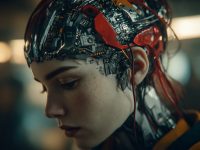














The first time I watched *Blade Runner*, I thought I understood it. Replicants bad, Deckard good, lots of rain and neon. Done. But that was before I'd spent three years tinkering with home automation systems and started wondering what consciousness actually meant when your coffee maker could remember your preferred brewing temperature better than you could remember your anniversary.
I've been keeping a running list of sci-fi films that completely transform on repeat viewings – not because they're confusing the first time around, but because they're built like Russian dolls. Each watch reveals another layer you missed, another question you didn't know was being asked. These aren't movies you solve; they're movies you inhabit differently each time.
*Arrival* hit me like a physics textbook to the face when I first saw it. Louise learning the heptapod language, time becoming non-linear – I was so focused on the linguistic mechanics that I missed the emotional gut punch entirely. Second viewing? I spent the whole film watching Amy Adams' micro-expressions, realizing she already knows her daughter's fate from minute one. The science fiction becomes secondary to this impossible choice: would you choose a life of profound joy knowing it comes packaged with devastating loss?
I actually paused the film halfway through that second watch to call my sister (yes, the one who used to mock my notebook scribbling). We ended up talking for two hours about whether foreknowledge negates free will or enables it. She's a pediatric nurse now, and she said something that stuck: "Every parent knows their child will eventually leave them, one way or another. We choose to love them anyway." That's when *Arrival* stopped being about aliens and started being about the human condition wrapped in extraordinary circumstances.
*Ex Machina* operates on a similar principle, though it took me three viewings to fully appreciate Alex Garland's sleight of hand. First time: I'm watching Nathan and Caleb debate AI consciousness. Second time: I'm studying Ava's subtle manipulations. Third time: I realize the real question isn't whether Ava is conscious – it's whether Nathan, Caleb, or any of us actually are. The film becomes a mirror, and suddenly you're the one being tested.

There's a scene where Ava asks Caleb what will happen to her if she fails the test. I initially read this as her showing concern for self-preservation (evidence of consciousness, right?). But watch it again – she's not asking because she's worried. She's asking because she already knows the answer and wants to see if Caleb will lie to her. She's testing *him*. The whole film flips.
*Annihilation* nearly broke my brain on first viewing. I spent weeks trying to figure out the rules of the Shimmer, sketching diagrams of DNA refraction, googling real scientific papers on genetic mutation. Completely missed the point. It's not a puzzle to solve; it's a mood to experience. The Shimmer doesn't follow rules because it represents something that can't be categorized or understood – the way grief or trauma or change itself works on us.
Natalie Portman's Lena lies to the camera throughout the entire film. She lies about her marriage, about her affair, about her motivations for joining the expedition. But watch her body language, her hesitations, the way she holds herself – she's telling the truth through performance even while the words are false. That's the kind of layered storytelling that only reveals itself when you already know where the plot is heading.
I spent last weekend rewatching *The Matrix* with my neighbor's teenager, who'd never seen it. Watching his face during the red pill/blue pill scene reminded me why this film works so well on repeat viewings – it's essentially two different movies depending on when you figure out Neo is already unplugged. Every scene in the first act becomes either a demonstration of the Matrix's control mechanisms or evidence of Neo's growing awareness. The same conversation carries completely different weight.
But here's what I didn't expect: the film's exploration of choice versus determinism hits differently now that I've spent years working with predictive algorithms. The Oracle doesn't predict the future – she influences it by making people believe certain things about themselves. It's a much more sophisticated (and troubling) form of control than simple force.
*Under the Skin* might be the ultimate rewatchable sci-fi film because it barely functions as narrative on first viewing. You're too busy trying to figure out what Scarlett Johansson's character is actually doing to notice how the film is studying human behavior like an anthropological document. Second time through, you can focus on the way people interact with her, how their behavior changes based on perceived vulnerability or attraction. It's deeply unsettling social science disguised as alien invasion story.

The beach scene still gives me chills – not because of the science fiction elements, but because of how accurately it captures human selfishness in crisis situations. That's pure observation, not speculation.
*Primer* deserves mention here, though it's almost cheating – the film is literally designed to be incomprehensible on first viewing. Shane Carruth built it like an engineering problem rather than a story, and you need multiple viewings just to track which version of each character you're watching in any given scene. But that structural complexity serves the theme: when you can change the past, every decision becomes exponentially more complicated. The form matches the content perfectly.
What these films share isn't visual spectacle or high concept premises – it's emotional sophistication disguised as intellectual puzzles. They trust viewers to do the work, to sit with discomfort, to find meaning in ambiguity. They reward attention and repay revisitation because they're built on foundations of real human behavior, even when the circumstances are impossible.
The best sci-fi films don't just imagine futures; they illuminate presents. They take current anxieties and push them just far enough into speculation to make them visible. That's why they keep working, why they reveal new things each time you return to them. The technology might be fictional, but the emotions are utterly real.
