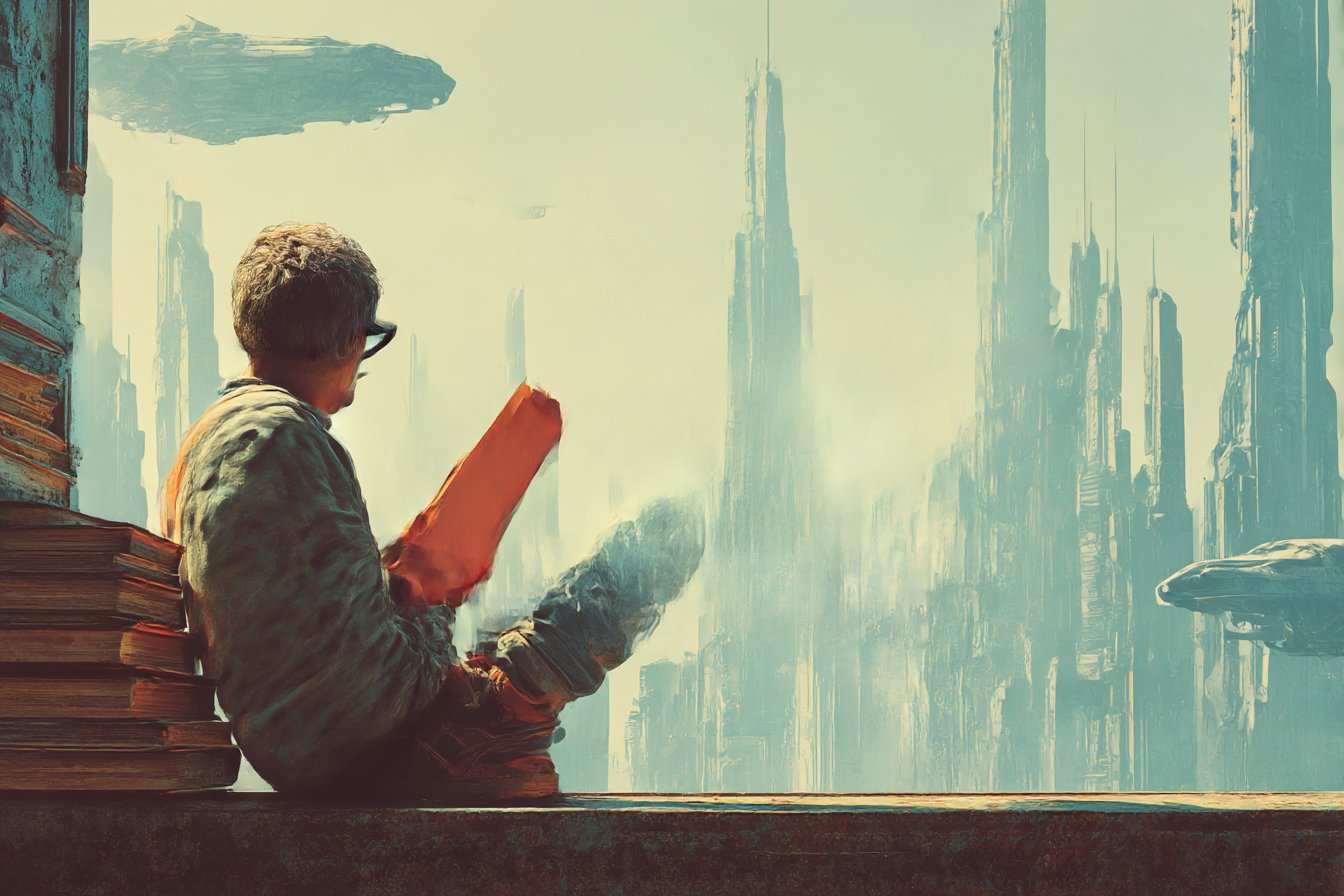

You know that moment when you finish a book and just sit there staring at the ceiling, your brain still buzzing with possibilities? That’s exactly what happened to me last Tuesday night after I’d torn through “The House You Pass on the Way” for the third time this year. My sister found me sprawled on the kitchen floor at 2 AM, paperback clutched to my chest, muttering something about parallel dimensions and teenage identity crises.
“Still reading those weird books,” she said, stepping over me to get water. Same comment she’s been making since we were kids.
But here’s the thing about young adult science fiction — when it’s done right, it doesn’t feel weird at all.
It feels essential. Like someone finally figured out how to translate the chaotic, questioning energy of being a teenager into stories about futures that might actually happen.
I’ve been thinking about this a lot lately, especially after spending last weekend at a local book festival where I watched a group of fifteen-year-olds practically vibrate with excitement over a battered copy of “The Left Hand of Darkness.” They were passing it around, pointing at specific passages, arguing about gender and ice planets with the kind of intensity I usually reserve for debating whether quantum computers could ever really achieve consciousness.
The books that work best for young readers aren’t the ones that talk down to them or oversimplify complex ideas. They’re the ones that trust teenagers to grapple with big questions while still caring about first kisses and friendship drama and whether they’ll ever figure out who they’re supposed to be.
Take “The Giver,” for instance. I must’ve read it seven times between ages twelve and seventeen, and each time I caught something new. First read? Just a weird story about a boy who sees colors. Second read? Holy hell, this is about controlled societies and the cost of safety. By the seventh read, I was lying awake thinking about whether emotional pain is worth preserving, whether we’d choose comfort over freedom, whether memories are what make us human.
That’s what great YA sci-fi does — it grows with you.
I remember discovering “Feed” by M.T. Anderson in a dusty corner of our local Waterstones. The cover looked ridiculous — all neon and corporate logos — but something about the premise grabbed me. Teenagers with internet connections hardwired into their brains, constant advertising streams, environmental collapse as background noise. This was 2002, mind you. Facebook didn’t exist yet. The iPhone was still five years away.
Reading it felt like Anderson had somehow seen our future and decided to warn us through a story about kids just trying to figure out how to be human in an increasingly inhuman world. The romance between Titus and Violet wasn’t just sweet — it was urgent, desperate, because you knew their time was limited by forces completely beyond their control.
That urgency is crucial. The best YA sci-fi doesn’t just explore futuristic concepts; it makes those concepts personal, immediate, emotionally unavoidable. In “The Handmaid’s Tale” (yes, I know it’s often shelved in adult fiction, but trust me, seventeen-year-olds are reading it), the horror isn’t really about the dystopian society — it’s about losing your name, your body, your choices. It’s about being reduced to a function.
You Might Also Like

I spent months after reading that book paying attention to every small freedom I took for granted. Walking to the shop without permission. Choosing what to wear. Having money in my own name. Margaret Atwood didn’t just build a scary future; she made me conscious of my present.
Then there’s the pure joy factor. “Hitchhiker’s Guide to the Galaxy” taught me that science fiction could be absolutely ridiculous and profoundly meaningful at the same time. Douglas Adams managed to pack genuine philosophical questions about existence, meaning, and our place in the universe into a story featuring depressed robots and vogon poetry. I still quote that book randomly in conversations, usually to my family’s horror.
“Don’t panic” became my personal mantra through A-levels. Still use it, actually.
More recently, I’ve been recommending “The Fifth Season” to every young reader I meet, though I always warn them it’s heavy. N.K. Jemisin doesn’t pull punches about oppression, environmental catastrophe, or the ways power systems crush individuals. But she also writes characters — especially Damaya, Syenite, and Essun — who feel absolutely real despite their extraordinary circumstances.
The magic system (if you can call geological powers magic) is so well-thought-out that I spent an entire weekend researching tectonic plate movements just to better understand how orogenes might actually work. That’s another thing great YA sci-fi does — it makes you curious about real science, real history, real social issues.
I’ve noticed that the books young readers get most excited about are often the ones adults find uncomfortable. “Parable of the Sower” by Octavia Butler is brutal — climate change, social collapse, religious extremism, economic inequality. But the teenagers I know who’ve read it don’t see it as depressing. They see Lauren Olamina as someone who refuses to give up, who builds something better from the ruins.
Maybe that’s because young readers aren’t afraid of imagining different futures. They haven’t spent decades getting comfortable with how things are. They’re naturally inclined toward “what if” thinking, toward questioning authority, toward believing change is possible.
The books that work best acknowledge that complexity. They don’t pretend teenagers are children who need protection from difficult ideas, but they also don’t forget that growing up is hard enough without adding unnecessary bleakness.
“Station Eleven” by Emily St.
John Mandel perfectly captures this balance. Yes, it’s about a pandemic that destroys civilization. But it’s also about art, memory, connection, the ways people create beauty even in the worst circumstances. The traveling symphony’s motto — “survival is insufficient” — has stuck with me for years.
That’s what I look for now when I’m browsing the sci-fi section: books that trust young readers to think, to question, to imagine better worlds while acknowledging the real challenges of the ones we have. Stories that remember being young isn’t just preparation for being an adult — it’s a valid, complex, important experience in itself.
Books that make you stare at the ceiling afterward, brain buzzing with possibilities. Even if your sister thinks they’re weird.

0 Comments