

The first time I truly understood the power of science fiction wasn’t in a cinema or at a convention — it was sitting cross-legged on my bedroom floor at thirteen, absolutely mesmerized by *Dune*. I’d borrowed it from the library after hearing older kids at school debate whether Paul Atreides was a hero or a cautionary tale. Three hundred pages in, I realized Herbert wasn’t just telling a story about desert planets and space politics. He was showing me how power corrupts, how ecology shapes civilization, and how prophecy can become a prison.
That book changed something fundamental in how I approached sci-fi. Before *Dune*, I thought the genre was mostly about cool gadgets and alien encounters — which, don’t get me wrong, I still love.

But Herbert demonstrated that the best science fiction uses tomorrow’s possibilities to examine today’s problems with surgical precision.
I started hunting down the books that had done this kind of heavy lifting for the genre, the ones that didn’t just entertain but fundamentally shifted what science fiction could accomplish. You know those works that make other writers go “Oh, we can do *that*?” and then spend decades trying to match their ambition.
Take Isaac Asimov’s *Foundation* series. When those stories first appeared in the 1940s, most sci-fi was still focused on bug-eyed monsters and ray guns. Asimov said, essentially, “What if we treated human civilization like a science?” He invented psychohistory — the idea that you could mathematically predict the behavior of large populations — and suddenly science fiction became a legitimate place to explore sociology, economics, and political theory. The ripple effects are still visible today in everything from *The Expanse* to climate fiction that models societal collapse.
I remember trying to explain Asimov’s influence to a friend who dismissed sci-fi as “just space opera nonsense.” I pulled out my worn copy of *Foundation* and showed him the passage where Hari Seldon predicts the fall of the Galactic Empire not through mysticism or luck, but through statistical analysis of historical patterns. “This was written before computers could even do proper calculations,” I told him. “Asimov was imagining data science before we had data.” My friend ended up borrowing the book. Never got it back, actually.
Then there’s Philip K. Dick, who basically invented the modern paranoid thriller by asking one simple question: How do we know what’s real? *Do Androids Dream of Electric Sheep?* didn’t just give us *Blade Runner* — it established the template for every story about artificial consciousness, corporate dystopia, and the blurring line between human and machine. Dick’s influence runs so deep that we barely notice it anymore. Every time a movie makes you question whether a character is an android, every time a TV show plays with false memories or simulated reality, that’s Dick’s DNA at work.
You Might Also Like

What fascinates me about Dick is how he made philosophical questions feel viscerally urgent. When I first read *Electric Sheep* (after seeing *Blade Runner*, I’ll admit), I spent weeks genuinely worried about whether my own memories were authentic. That’s the mark of transformative fiction — it doesn’t just make you think differently while reading, it changes how you see the world afterward.
Ursula K. Le Guin accomplished something similar but from a completely different angle. *The Left Hand of Darkness* took the sci-fi tradition of exploring alien cultures and used it to examine gender in ways that were revolutionary for 1969 — and honestly, still feel radical today. Le Guin’s Gethenians, who are ambisexual and only develop male or female characteristics during their monthly fertile period, forced readers to confront assumptions about identity, relationships, and power that most had never questioned.
I tried to explain Le Guin’s achievement to a group at a book club once, and this guy kept insisting it was “just about aliens being weird.” But that completely missed the point. Le Guin wasn’t interested in alien weirdness for its own sake — she was using an alien perspective to make familiar human behavior look strange and worth examining. It’s probably the most elegant example I know of sci-fi’s unique ability to defamiliarize the present by imagining alternative futures.
*Neuromancer* by William Gibson deserves special mention because it basically created cyberpunk and, arguably, predicted the internet. When Gibson described cyberspace in 1984 — “a consensual hallucination experienced daily by billions” — most people had never touched a computer. Yet somehow he intuited not just the technology but the culture that would grow around it. The idea that virtual spaces could be more compelling than physical reality, that corporations would colonize digital frontiers, that hackers would become folk heroes — Gibson saw all of it coming.
I still get chills reading the opening line: “The sky above the port was the color of television, tuned to a dead channel.” That single sentence establishes mood, setting, and worldview with surgical efficiency. It tells you everything about how technology has infiltrated consciousness in this world. Every cyberpunk story since has been either building on Gibson’s foundation or deliberately reacting against it.
But here’s what really impresses me about these foundational works — they didn’t just influence other books, they shaped how we think about real-world issues. Politicians reference *1984* (yes, I know, technically Orwell, but bear with me). Tech entrepreneurs name their companies after concepts from *Foundation*. Climate scientists point to *The Windup Girl* when explaining potential futures. Urban planners cite *The City & The City* when discussing segregation.
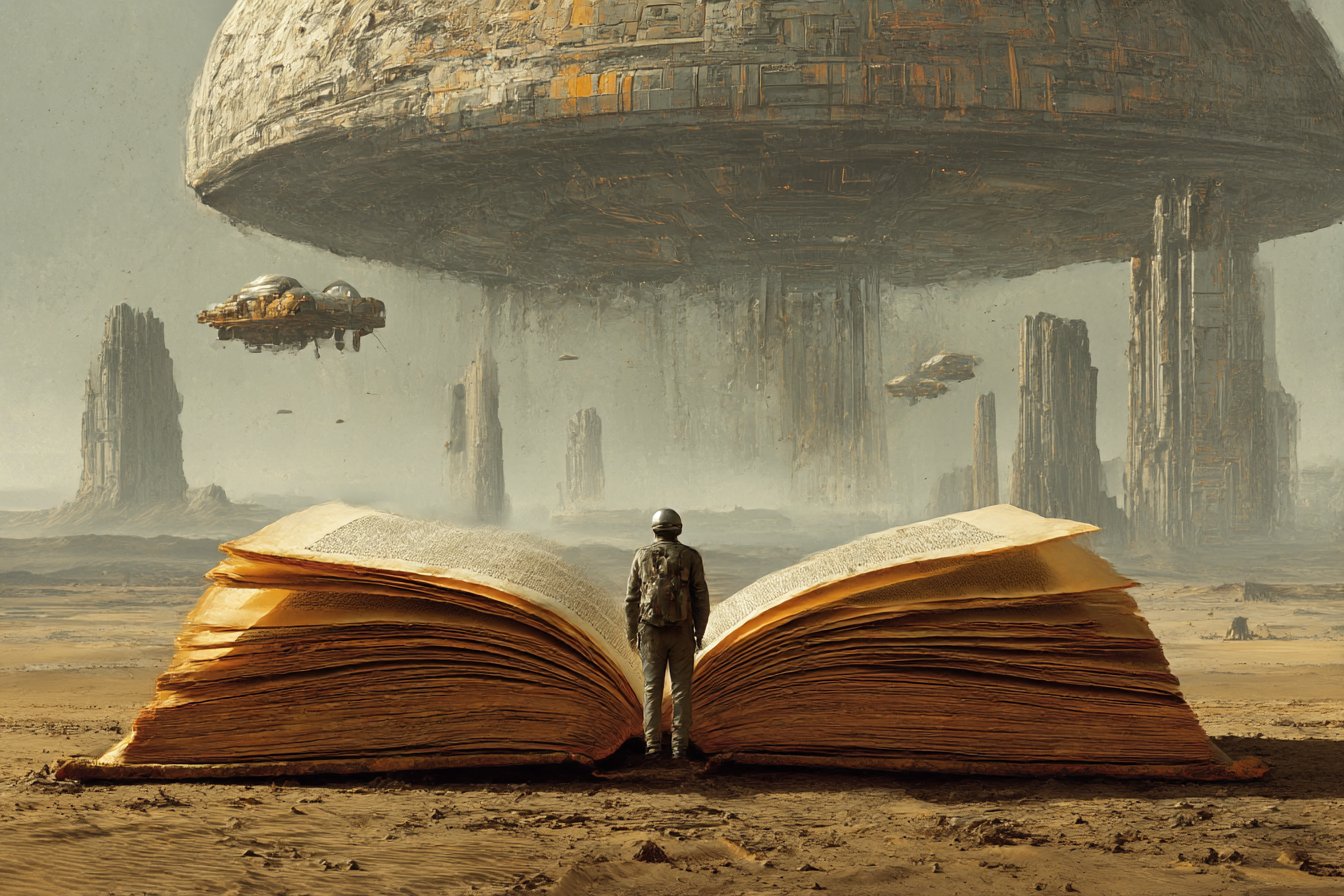
The most powerful sci-fi doesn’t just predict the future — it helps create it by expanding our sense of what’s possible. When I look at my bookshelf now, I can trace direct lines of influence from these classics to contemporary works that continue pushing boundaries. Kim Stanley Robinson’s *Mars* trilogy builds on Herbert’s ecological worldbuilding. Martha Wells’ *Murderbot Diaries* extends Dick’s questions about artificial consciousness. Becky Chambers’ *Wayfarers* series reimagines Le Guin’s gentle anthropology for a new generation.
What strikes me most is how these influential books succeeded not by being safe or predictable, but by taking enormous risks. They asked uncomfortable questions, challenged prevailing assumptions, and trusted readers to follow them into genuinely unfamiliar territory. Maybe that’s the real lesson here — the sci-fi that lasts isn’t the stuff that plays it safe, but the work that’s brave enough to imagine genuinely different ways of being human.

0 Comments