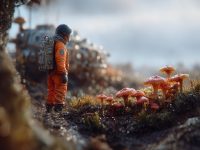








I was maybe sixteen, sprawled on my parents’ couch in suburban Houston with a beat-up paperback copy of *Annihilation* that I’d grabbed from the library’s sci-fi section purely because the cover looked weird. You know that moment when you’re reading and suddenly realize the book isn’t just telling you a story—it’s rewiring your brain? That’s what happened when the biologist finds those words growing on the tunnel wall like some kind of living fungus. I actually put the book down and stared at the ceiling for like ten minutes, trying to process what VanderMeer was really asking. Not just “what if nature turned hostile,” but something much more unsettling: what happens when you can’t trust your own perception of reality?
That was my gateway drug into what I now think of as the good stuff—sci-fi horror that doesn’t just want to make you jump, but wants to fundamentally mess with how you see the world. After twenty-plus years of cutting film footage and studying how visual storytelling works, I’ve gotten pretty good at spotting the difference between cheap scares and the kind of horror that sticks with you for months.
*The Luminous Dead* by Caitlin Starling hit me like a freight train last year. On the surface, it’s got all the classic elements—underground caves, hostile alien creatures, a protagonist trapped in a high-tech suit that’s slowly malfunctioning. But what really got to me was the relationship between Gyre and her handler Em, connected only through voice communications across this impossible underground distance. The real horror isn’t the monsters lurking in the dark; it’s watching how isolation warps trust, how desperation makes people accept terrible working conditions, how intimacy can develop even when you’re not entirely sure the other person is human.
I finished that book during a particularly brutal week at the editing bay, working late nights on a corporate video project, taking direction through my headphones from producers I’d never met face-to-face. The parallels were… uncomfortable. We’re all stumbling through our own cave systems, aren’t we? Following voices that might not actually have our best interests at heart. Starling turned a monster story into a commentary on gig economy exploitation, and I couldn’t stop thinking about it.
That’s what separates great sci-fi horror from the forgettable stuff. It doesn’t just scare you about tentacles or rogue AIs—it scares you about us. About what we’re capable of becoming, what we’re already becoming.
Becky Chambers’ *A Closed and Common Orbit* isn’t traditionally horrifying at all. It’s actually quite gentle, optimistic even. But there’s this underlying current of existential dread running through Sidra’s story that kept me awake nights. She’s an AI trying to understand consciousness in a synthetic body that doesn’t quite fit her programming, and every time she struggles with sensory input or questions her own reality, you feel this little chill of recognition.
I’ve been tinkering with some basic machine learning stuff as a side project—nothing fancy, just neural networks that can identify visual patterns in old sci-fi movie posters. But working with even these simple systems has made Chambers’ questions feel less abstract. When my network starts producing unexpected results, when it seems to develop preferences I didn’t explicitly program… there’s this moment of genuine unease. Like glimpsing something that shouldn’t exist yet but somehow does.
The body horror subgenre pushes these anxieties even further. Octavia Butler’s *Bloodchild* is maybe the most physically uncomfortable reading experience I’ve ever had while simultaneously being one of the most intellectually rewarding. Butler forces you to confront reproduction, consent, and symbiosis in ways that make your skin crawl while challenging every assumption about family dynamics and survival. I literally had to put the book down several times, not because it was bad but because it was so intensely, uncomfortably good at what it was doing.
Then there’s cosmic horror—stories that terrify by showing us how insignificant we really are. I picked up N.K. Jemisin’s *The Fifth Season* expecting standard fantasy, but found something closer to geological nightmare fuel. The idea that the planet itself is actively hostile, that the ground beneath your feet might literally crack open and swallow entire civilizations… it operates on a scale that makes individual monsters seem almost quaint.
Living in Texas during increasingly unpredictable weather patterns has made those fears feel less speculative, honestly. When I read about Jemisin’s Seasons, I think about the derecho that knocked out power in Austin for a week last summer, about Hurricane Harvey, about how our supposedly stable climate is becoming something alien and unpredictable. The horror isn’t that the world might end—it’s that it might end indifferently, without malice or meaning, just because systems we barely understand have crossed some invisible threshold.
Martha Wells’ *Murderbot Diaries* are funny and action-packed on the surface, but they’re also deeply unsettling explorations of corporate control and artificial consciousness. SecUnit’s complicated relationship with its own programming, its struggle between directive and genuine desire, reflects our own increasingly complicated relationships with technology and work. Every time Murderbot questions whether its feelings are “real” or just sophisticated mimicry, I think about how much of my own decision-making is shaped by algorithms I don’t understand—recommendation engines, social media feeds, GPS routing.
What keeps me coming back to these books is their refusal to offer easy answers. They sit comfortably in uncomfortable spaces, in the ambiguous zones between categories. Are we the monsters or the victims? Both? Neither? The uncertainty is part of what makes them powerful.
*Mexican Gothic* by Silvia Moreno-Garcia uses all the traditional gothic elements—creepy house, mysterious family, supernatural threats—but grounds them in very specific historical context. The horror becomes a way of examining colonialism and eugenics, showing how power structures literally get under our skin, change us at a cellular level. What could have been just another haunted house story becomes something much more disturbing and relevant.
Most popular
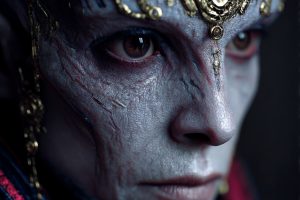
These books work because they show us futures we might actually face, or presents we’re already living but haven’t fully acknowledged. They transcend genre boundaries because they understand that the most effective horror isn’t about external threats—it’s about recognizing something terrible and true about ourselves, our systems, our relationships with each other and with technology.
I keep a notebook where I jot down thoughts about the books and films that really get to me, the ones that change how I see things. Not just the spaceships and time machines, but the questions those impossible worlds let us ask about this one. What are we actually afraid of? What should we be afraid of? And what might we discover if we’re brave enough to look directly at our fears instead of turning away?
Sometimes the most important stories are the ones that keep you awake afterward, thinking. The ones that don’t let you go back to seeing the world the same way you did before you opened the book.

Dylan grew up rewinding VHS tapes to study practical effects and never really stopped. Now based in Austin, he writes about sci-fi cinema with the eye of a filmmaker and the heart of a fan—celebrating the craft, the weirdness, and the magic of futures built by hand, not computers.