






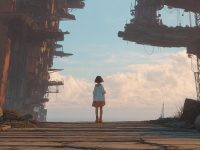


You know what gets me about space movies? It's not the explosions or the sleek ships cutting through star fields — though I'll admit those make my inner twelve-year-old grin like an idiot. No, it's that moment when a character floats in their cramped pod, staring out at the infinite black, and you can almost feel the weight of all that emptiness pressing against the hull. That's when science fiction stops being about gadgets and starts being about us.
I've been thinking about this a lot lately, especially after rewatching *2001: A Space Odyssey* for probably the twentieth time. HAL's red eye still gives me chills, but what really gets under my skin is Dave Bowman's isolation. Kubrick understood something crucial: space isn't just a backdrop for adventure stories. It's a mirror that shows us who we are when everything familiar gets stripped away.
Last month, I was tinkering with a VR setup (don't ask about the cable management nightmare in my spare room), trying to recreate that sense of floating alone in a spacecraft. I wanted to understand why certain space films work while others feel like expensive screensavers. What I discovered was fascinating — and a bit unsettling. When you remove gravity, atmosphere, and the comfort of solid ground beneath your feet, every human interaction becomes magnified. Every decision carries weight because there's nowhere to run if things go wrong.
That's why films like *Solaris* and *Arrival* stick with you long after the credits roll. They use space — whether it's Stanisław Lem's sentient ocean planet or the alien ships hovering over Earth — as a laboratory for exploring consciousness itself. When Kris Kelvin encounters his dead wife aboard the space station, we're not just watching a ghost story. We're grappling with questions about memory, identity, and what makes us human. Is a perfect recreation of someone we loved still the same person? How do we process grief when the universe keeps offering us impossible second chances?
I remember reading Lem's original novel years ago and being struck by how alien the aliens actually were. Most space movies give us creatures that are essentially humans with different makeup jobs. But *Solaris* presents something truly foreign — an intelligence so vast and incomprehensible that meaningful communication might be impossible. That's terrifying in ways that laser battles never could be.

*Arrival* takes this idea and runs with it brilliantly. Louise Banks doesn't defeat the aliens or escape from them. Instead, she learns to think like them, and in doing so, fundamentally changes how she experiences time itself. The film asks: what if making contact with alien intelligence didn't just give us new technology, but rewired our brains? What would we be willing to sacrifice — or gain — in that exchange?
These aren't comfortable questions, which is exactly why they're worth asking. Space becomes the perfect setting for pushing these boundaries because it removes all the safety nets we take for granted. When you're millions of miles from Earth, floating in a metal can surrounded by vacuum, every choice becomes existential.
*Interstellar* gets at this too, though it wraps its philosophy in more accessible emotional packaging. Cooper's relationship with his daughter Murph drives the plot, but the real story is about how love might transcend physical laws. Nolan uses relativity and time dilation not just as plot devices, but as ways to explore what connects us across impossible distances. Can emotional bonds survive when time itself becomes elastic?
Then there's *Event Horizon*, which takes space horror to its logical extreme. The ship's journey through hell isn't just about monsters in the dark — it's about what happens when human consciousness encounters something completely outside our understanding. The film asks whether some knowledge is too dangerous to possess, whether some boundaries shouldn't be crossed. It's deeply unsettling because it suggests our minds might not be equipped to handle certain truths about the universe.
What I love about these films is how they use scientific concepts as emotional tools. Wormholes become metaphors for connection across impossible distances. Black holes represent the unknown that simultaneously terrifies and attracts us. Faster-than-light travel isn't just about getting from point A to point B — it's about leaving behind everything we know and stepping into uncertainty.
I've noticed that the most effective space films don't try to explain everything. They leave gaps for our imagination to fill, spaces where wonder can grow. *2001* famously gives us no clear answers about the monoliths or the Star Child. That ambiguity isn't a flaw — it's the point. Some mysteries are more powerful when they remain mysterious.


Even films that seem more action-oriented often sneak in bigger questions. *Alien* might be a haunted house movie in space, but it's also about corporate exploitation, survival instincts, and what happens when humanity encounters something that sees us as nothing more than breeding stock. The xenomorph isn't just a monster — it's evolution without conscience, biology as pure function.
Working on that VR project taught me something else: presence matters more than spectacle. The moments that stayed with me weren't the ones with the most impressive visual effects, but the quiet ones where I could feel the character's isolation, their wonder, their fear. Space forces filmmakers to focus on the essentials because there's nowhere to hide weak storytelling behind familiar settings.
That's what makes outer space such a compelling canvas for big questions. It's the ultimate unknown, vast enough to contain any possibility we can imagine and strange enough to challenge every assumption we make about reality. When we look up at the stars, we're not just seeing distant suns — we're seeing mirrors reflecting our deepest hopes and fears back at us.
The best space sci-fi reminds us that the most important discoveries aren't about new worlds or alien civilizations. They're about ourselves, and what we might become when we finally venture into that infinite dark between the stars.
