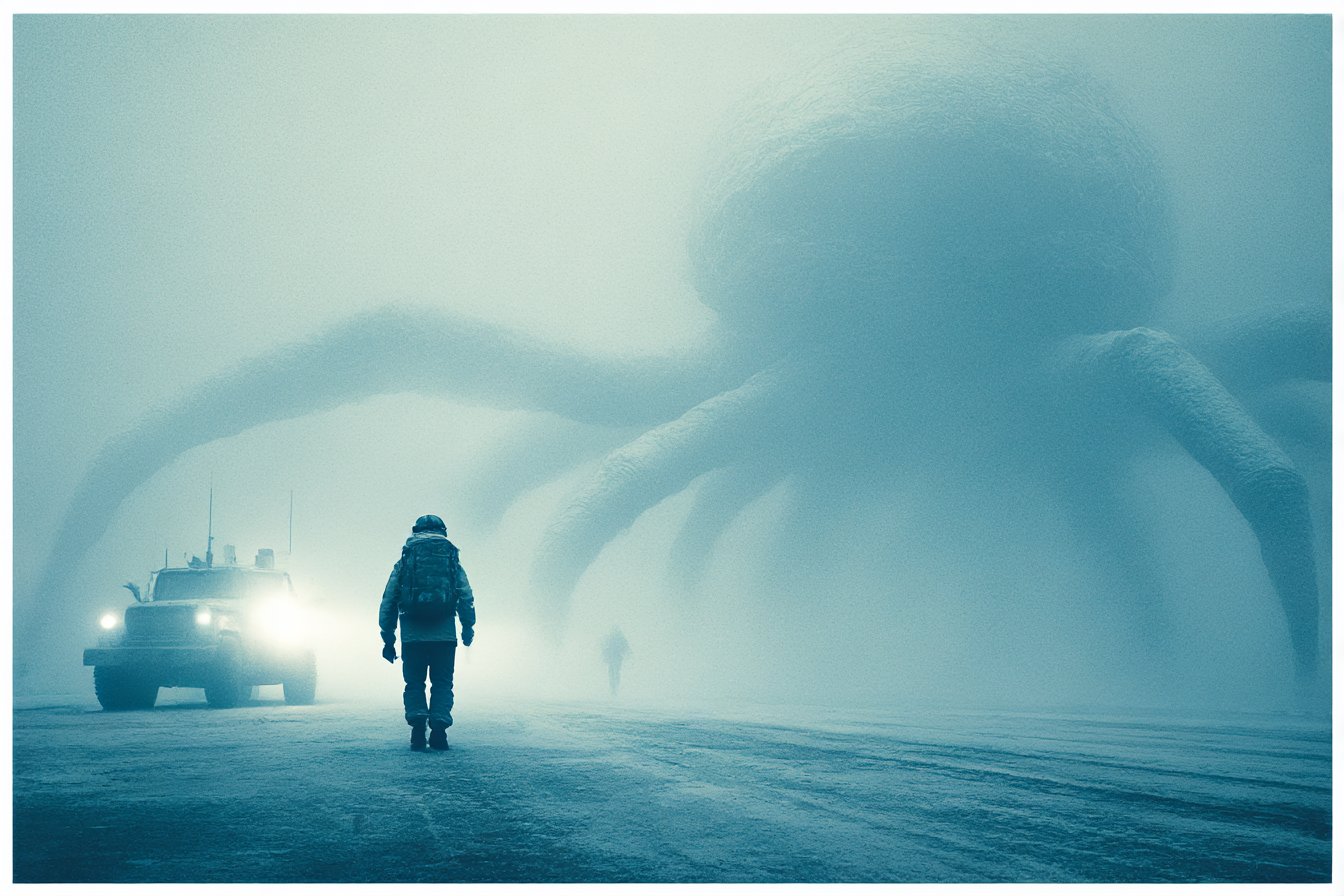

Last weekend, I found myself alone in my flat at two in the morning, rewatching John Carpenter's *The Thing* for what must be the dozenth time. My neighbour's heating system was making these unsettling clicking noises through the wall – the kind that makes you wonder if something's moving around in there that shouldn't be. Perfect timing, really.
What struck me this time wasn't the practical effects (though they're still phenomenal) or even the mounting paranoia between the characters. It was something more fundamental: how the film builds its terror not through jump scares or gore, but through the slow erosion of certainty. Every time I watch it, I'm reminded why this particular slice of sci-fi horror has never lost its grip on audiences, even forty years later.
You know what's brilliant about *The Thing*? It weaponises trust itself.
The alien doesn't just mimic its victims – it becomes them so completely that there's no reliable way to tell who's human and who isn't. I've been thinking about this a lot lately, especially given how much we're hearing about deepfakes and AI-generated content. Carpenter was exploring ideas about identity and authenticity that feel remarkably prescient now.
The genius lies in the setup. Twelve men isolated in an Antarctic research station, cut off from the outside world. When you can't call for help and you can't run away, every interpersonal dynamic becomes magnified. I remember reading an interview where Carpenter mentioned he wanted to strip away all the usual escape routes – no cavalry coming over the hill, no mobile phones, no convenient plot devices. Just people trapped with an unknowable threat that could be anyone.
What really gets under your skin is how the paranoia spreads. Blair's computer simulation early in the film calculates that if the Thing reached a major population centre, it would assimilate the entire human race within 27,000 hours. That's roughly three years. But the real horror isn't the cosmic-scale threat – it's watching these men turn on each other, knowing that suspicion itself becomes a kind of contagion.

I've always been fascinated by the film's use of practical effects over CGI. Rob Bottin, who designed the creature work, spent months creating these grotesque transformation sequences using puppets, animatronics, and clever camera tricks. There's something viscerally unsettling about knowing that what you're seeing actually existed in physical space, that the actors were reacting to real objects rather than tennis balls on sticks.
The chest-burster scene still makes me wince. Not because it's particularly gory by today's standards, but because it subverts expectations so perfectly. You think you're watching a medical emergency – CPR, defibrillation, the usual – and then Norris's chest opens up like a mouth and bites off Copper's hands. The transition from mundane to nightmarish happens so quickly you barely have time to process it.
You Might Also Like

But here's what I find most interesting: the Thing itself remains largely unexplained. We get hints – it's been frozen for 100,000 years, it crashed in a spacecraft, it's driven by some kind of survival instinct. That's it. No exposition dumps about its home planet or its motivations. The mystery deepens rather than resolves, and that ambiguity is crucial to why the film works.
I tried explaining this to my sister once (the same one who used to mock my sci-fi notebook), and she made an interesting point: "It's like a perfect metaphor for any kind of social breakdown, isn't it? The moment you can't trust the people around you, everything falls apart." She's not wrong. The Thing works as Cold War paranoia, as commentary on McCarthyism, as fear of infectious disease, as anxiety about technological replacement of humans. The alien becomes whatever social fear you project onto it.
The ending is particularly masterful. MacReady and Childs sitting in the ruins of the station, both exhausted, both suspicious of the other. The audience knows one of them might be the Thing, but there's no way to be certain. Some fans have spent decades analysing every detail – who's breathing produces visible vapor in the cold, who drinks from the bottle of scotch, the subtle implications of their dialogue. The fact that we're still debating it shows how effectively Carpenter planted that seed of uncertainty.
From a technical standpoint, the film demonstrates something I wish more modern sci-fi would embrace: restraint. The special effects serve the story rather than overwhelming it. The creature reveals are carefully rationed, allowing tension to build between encounters. Compare this to contemporary horror films that front-load their monsters, showing everything in the first act and then struggling to maintain interest.

I've watched behind-the-scenes footage of the production, and what comes across is how seriously everyone took the material. These weren't actors phoning it in for a quick paycheck. Kurt Russell brings real gravitas to MacReady, making him paranoid but not hysterical, capable but not invincible. The supporting cast – Keith David, Wilford Brimley, Richard Dysart – each create distinct personalities that make their eventual distrust of each other genuinely painful to watch.
The sound design deserves mention too.

Ennio Morricone's minimalist score uses synthesisers and unconventional instruments to create this sense of mounting dread. It's not traditionally melodic – more like industrial noise shaped into something resembling music. Combined with the constant howling of Antarctic wind, it creates an audio environment that feels hostile and alien even before the creature appears.
What keeps bringing me back to *The Thing* is how it earns its scares. Nothing feels cheap or manipulative. The horror emerges naturally from the situation and the characters' reactions to it. It respects its audience enough to let us fill in the gaps, to imagine the worst possibilities rather than showing us everything explicitly.
That's the mark of enduring sci-fi horror: it plants ideas that keep growing in your mind long after the credits roll. Even now, typing this at my kitchen table, I'm acutely aware of every small sound in the building. The Thing's greatest achievement is making ordinary spaces feel potentially threatening, transforming the familiar into something unknowable.

0 Comments