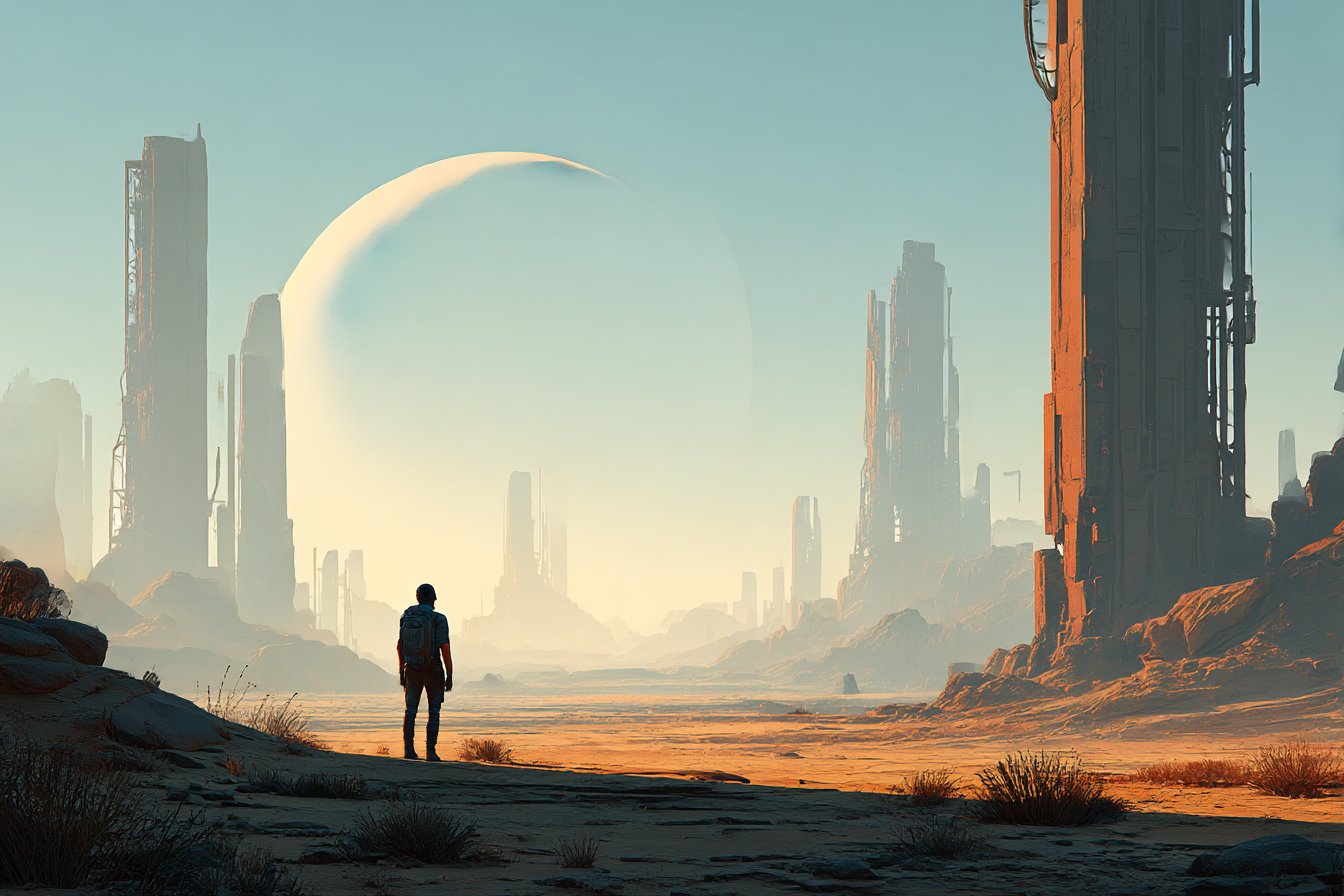

You know that moment when you're walking through a digital world and something just clicks? Not the flashy explosions or the perfect graphics, but something smaller — maybe it's the way rust flakes off a metal door when you touch it, or how your character's breath fogs up in a cold corridor. I had one of those moments playing an old indie game about abandoned research stations. The developers had programmed in this tiny detail: when you walked past certain vents, you could hear the distant hum of machinery that was supposedly keeping life support running. It wasn't necessary for gameplay. Most players probably didn't even notice.

But it made the whole place feel alive.
That's when I realized what separates truly immersive sci-fi games from the ones that just look pretty. It isn't about having the biggest budget or the most cutting-edge tech. It's about understanding that believability lives in the margins.
I've spent countless hours dissecting what makes some digital futures feel real while others fall flat. The answer usually comes down to consistency and consequence. The best sci-fi games don't just show you a world — they make you understand how it works, why it exists, and what it costs to maintain.
Take something as simple as lighting. In most games, lights just… work. They're always on, perfectly positioned for dramatic effect. But I remember playing through a game where the lighting actually responded to the story. When power was running low, certain sections would dim. Emergency lighting would kick in with that harsh red glow we all associate with danger. The computer terminals would switch to power-saving mode, their screens flickering with lower refresh rates. None of this was explained through exposition — you just lived it.
This attention to systemic thinking is what separates amateur world-building from professional craft. Every element should feel connected to every other element. If your game features faster-than-light travel, then how does that affect communication? If people can upload their consciousness, what happens to their bodies? If artificial intelligence has become commonplace, why are humans still doing certain jobs?

I spent weeks once trying to map out the economic system in a space trading game, just to see if it held together. Most players were focused on combat and exploration, but I wanted to understand whether the supply chains actually made sense. Turns out, they did. The developers had thought through which planets would produce what resources, how transportation costs would affect prices, even how political tensions would disrupt trade routes. That invisible foundation made every transaction feel meaningful.
The emotional core matters just as much as the logical framework. Science fiction works best when it grounds extraordinary circumstances in recognizable human experiences. Fear, loneliness, wonder, frustration — these don't change just because we're dealing with laser guns and alien encounters.
I've noticed that the most affecting sci-fi games are often the ones that focus on small, intimate moments within their vast settings. A message from home that takes months to reach your deep space mining station. The awkward conversation with an AI that's trying too hard to seem human. The moment when you realize the "abandoned" facility you're exploring still has someone living in it.
You Might Also Like

One game I played recently did something brilliant with this concept. You're part of a generation ship traveling to a distant planet — a journey that will take centuries. Your character lives their entire life aboard this vessel, never seeing the destination. The game doesn't focus on epic space battles or first contact scenarios. Instead, it's about the weird social dynamics of a closed community, the way traditions evolve over generations, the tensions between people who want to preserve Earth culture and those who think they should adapt to their new reality.
What made it work was how the developers thought through the ripple effects of their premise. How do you maintain genetic diversity in a small population? What happens to democracy when there's literally nowhere to emigrate if you don't like the government? How do you preserve knowledge across multiple generations without the internet? The game didn't lecture you about these issues — it just let you experience them.
The technical aspects of world-building matter too, but not in the way most people think. It's not about having scientifically accurate physics simulations or perfectly rendered textures. It's about creating systems that feel purposeful and interconnected.
I remember spending an afternoon with a game developer who was working on a survival game set on Mars. We were discussing how to make the environment feel genuinely hostile without being frustrating. The key insight was that danger should come from the environment's indifference, not its malevolence. Dust storms aren't trying to kill you — they're just weather. Equipment failures aren't personal attacks — they're the inevitable result of operating complex machinery in harsh conditions.
This led to some fascinating design decisions. Instead of having dramatic equipment failures at scripted story moments, the game would gradually degrade your gear based on usage and environmental exposure.

You'd notice your solar panels becoming less efficient as dust accumulated. Your radio communications would develop static during certain atmospheric conditions. Your habitat modules would require increasingly frequent maintenance as seals wore out and filters clogged.

The result was a world that felt genuinely alien without relying on monster jumpscares or arbitrary difficulty spikes. The challenge came from adapting to an environment that operated by different rules than Earth, not from fighting enemies that seemed designed specifically to frustrate players.
I've come to believe that the most successful sci-fi games are the ones that trust their players to pick up on subtleties. They don't need to explain every detail of their world-building through exposition dumps or tutorial sequences. Instead, they let you discover how things work through experimentation and observation.
The best sci-fi games understand that immersion isn't about fooling players into thinking they're somewhere else — it's about giving them enough consistent, believable detail that they want to believe. Once players buy into your world's internal logic, they'll help maintain the illusion themselves, filling in gaps and making excuses for inconsistencies because they're invested in the experience.
That's the real magic of interactive science fiction. It doesn't just show you possible futures — it lets you inhabit them, consequences and all.

0 Comments