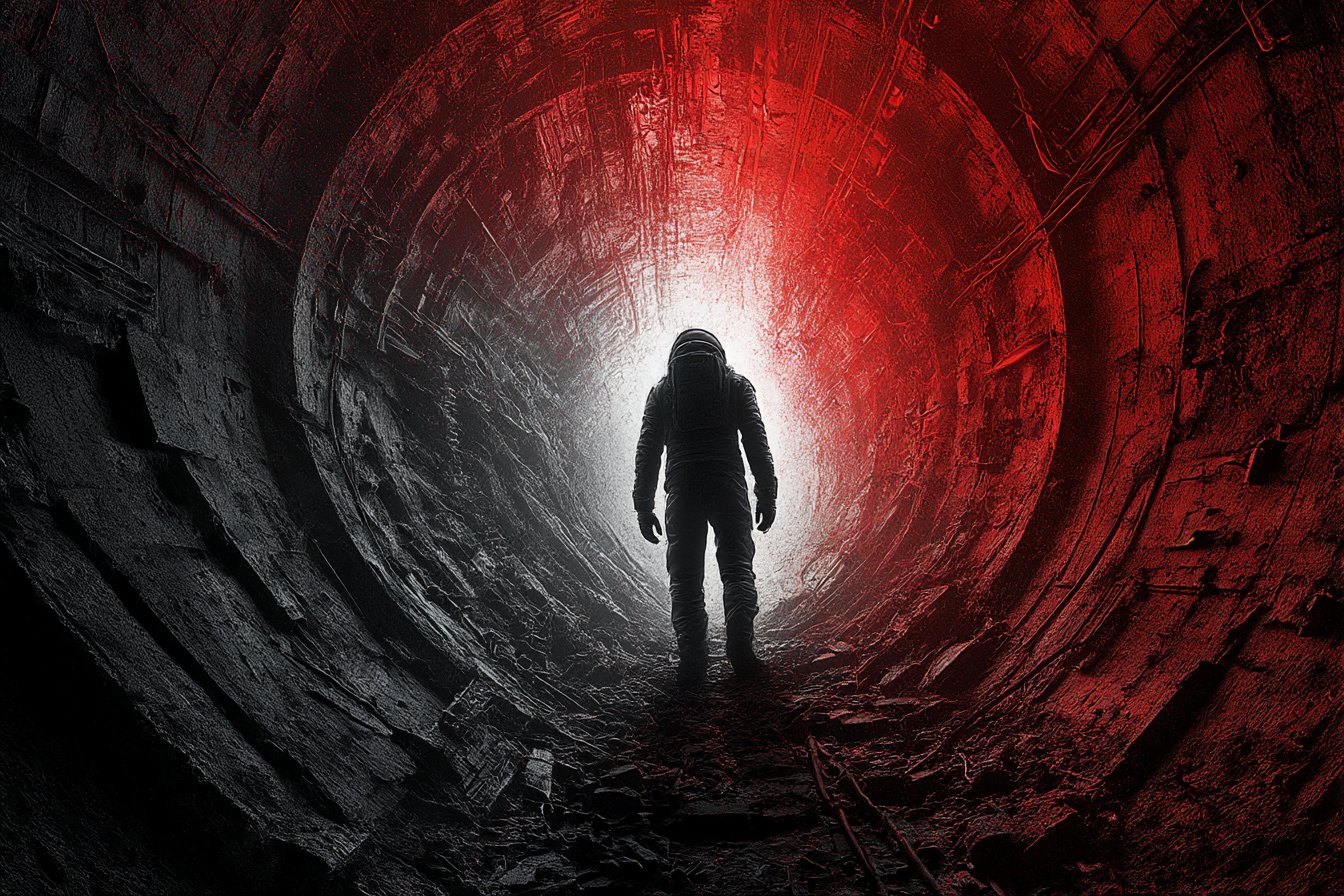

You know that feeling when you walk into a room and something’s just… wrong? Maybe the shadows fall at odd angles, or there’s a sound you can’t quite place. That’s exactly what hit me the first time I watched Pandorum back in 2009. I’d grabbed it on a whim from the sci-fi section at Blockbuster (yeah, I’m dating myself here), expecting another generic space thriller. What I got instead was something that crawled under my skin and stayed there.
The film opens with Dennis Quaid’s character waking up in what looks like a coffin made of metal and wires.
Right away, you’re thrown into this claustrophobic nightmare where everything feels slightly off-kilter. I remember thinking, “This isn’t how most space movies start.” Usually, there’s some grand establishing shot of a gleaming starship against the cosmos. Here? Just darkness, confusion, and the immediate sense that something’s gone terribly wrong.
What struck me most about Pandorum wasn’t the monster design or the jump scares – though those were effective enough. It was how the film approached the idea of deep space as this fundamentally hostile environment, not just because of vacuum or radiation, but because of what isolation does to the human mind. The titular “pandorum” is essentially space madness, a psychological breakdown that occurs during extended periods in hypersleep. It’s a brilliant concept because it makes the technology that should save us – suspended animation for long-haul space travel – into the very thing that destroys us.
I spent weeks after watching it trying to work out the physics of their spaceship, the Elysium. The rotating sections, the way gravity works in different areas, the hydroponics bays that have become these twisted jungle environments. It felt plausible in a way that most sci-fi ships don’t. You could imagine actually living in those spaces, working in them, slowly going mad in them.
The production design deserves serious credit here. Most space horror films either go for the sterile, Apple Store aesthetic or the grimy, industrial look of Alien. Pandorum splits the difference brilliantly. The ship feels lived-in but also decaying, functional but unreliable. When I was working on that space station mod I mentioned earlier, I kept coming back to screenshots from this film. The way light filters through damaged hull plating, how water drips create these rhythmic soundscapes, the organic growth patterns spreading across metal surfaces – it all contributes to this sense of a living, breathing environment that’s slowly dying.
But here’s what really makes Pandorum special in the sci-fi horror canon: it doesn’t rely on a single monster or external threat. The horror comes from multiple sources working in concert. You’ve got the psychological breakdown of the crew, the mysterious creatures that have adapted to life aboard the ship, the gradual revelation of how long they’ve actually been traveling, and the creeping suspicion that their mission might be pointless anyway. Each layer builds on the others until you’re not sure what’s real and what’s delusion.
I’ve shown this film to friends who primarily watch mainstream sci-fi, and their reactions are always interesting. Some can’t get past the claustrophobic cinematography – all those tight corridors and flickering lights make them genuinely uncomfortable. Others get caught up trying to figure out the timeline and miss the emotional core entirely. But the ones who really get it always comment on how the film makes space travel feel dangerous again, not in the heroic Star Trek way, but genuinely, existentially terrifying.
You Might Also Like

The creatures in Pandorum – these pale, adapted humans who’ve essentially devolved over generations – represent one of the most unsettling concepts in sci-fi: what we might become if we push too far beyond our natural limits. They’re not aliens in the traditional sense; they’re us, changed by circumstances we created. When I first saw them, I immediately thought of H.G. Wells’ Morlocks, but these feel more plausible, more rooted in actual evolutionary biology.
What’s fascinating is how the film handles information. You’re dropped into the middle of the story with no context, just like the characters. We discover the truth about their situation at the same pace they do, which creates this mounting dread as each revelation makes things worse, not better. Learning they’ve been traveling for decades, that Earth might be gone, that their “rescue mission” was actually an escape – each twist reframes everything that came before.
The sound design deserves mention too. I’ve got a decent home theater setup, and watching Pandorum with proper surround sound is genuinely unnerving. The constant groaning of metal under stress, the dripping, the skittering of creatures in the walls – it creates this audio landscape that makes you feel like you’re actually trapped inside a dying spaceship. I had to turn it down during one late-night viewing because my neighbor knocked on the door asking if everything was okay.
Looking back now, more than a decade later, Pandorum feels almost prophetic. Here we are seriously discussing multi-generational spacecraft for Mars missions, suspended animation for long-duration space travel, closed-loop life support systems. The film asks uncomfortable questions: What happens to human psychology during voyages that last longer than civilizations? How do we maintain purpose and sanity across generations?
What if the place we’re trying to reach doesn’t exist anymore?
These aren’t just theoretical concerns. They’re engineering problems we’ll actually have to solve if we’re serious about interstellar travel. Pandorum suggests that the technical challenges might be the easy part compared to the human ones.
The film bombed at the box office, probably because it was too weird for mainstream audiences and too mainstream for horror purists. But that’s often how the best sci-fi works – it exists in the spaces between genres, asking questions that nobody else is asking. Pandorum earned its place in that tradition by taking familiar elements and pushing them just far enough off-center to make us genuinely uncomfortable with our assumptions about progress, technology, and human nature.
Sometimes the best sci-fi isn’t about where we’re going, but what we might lose getting there.

0 Comments