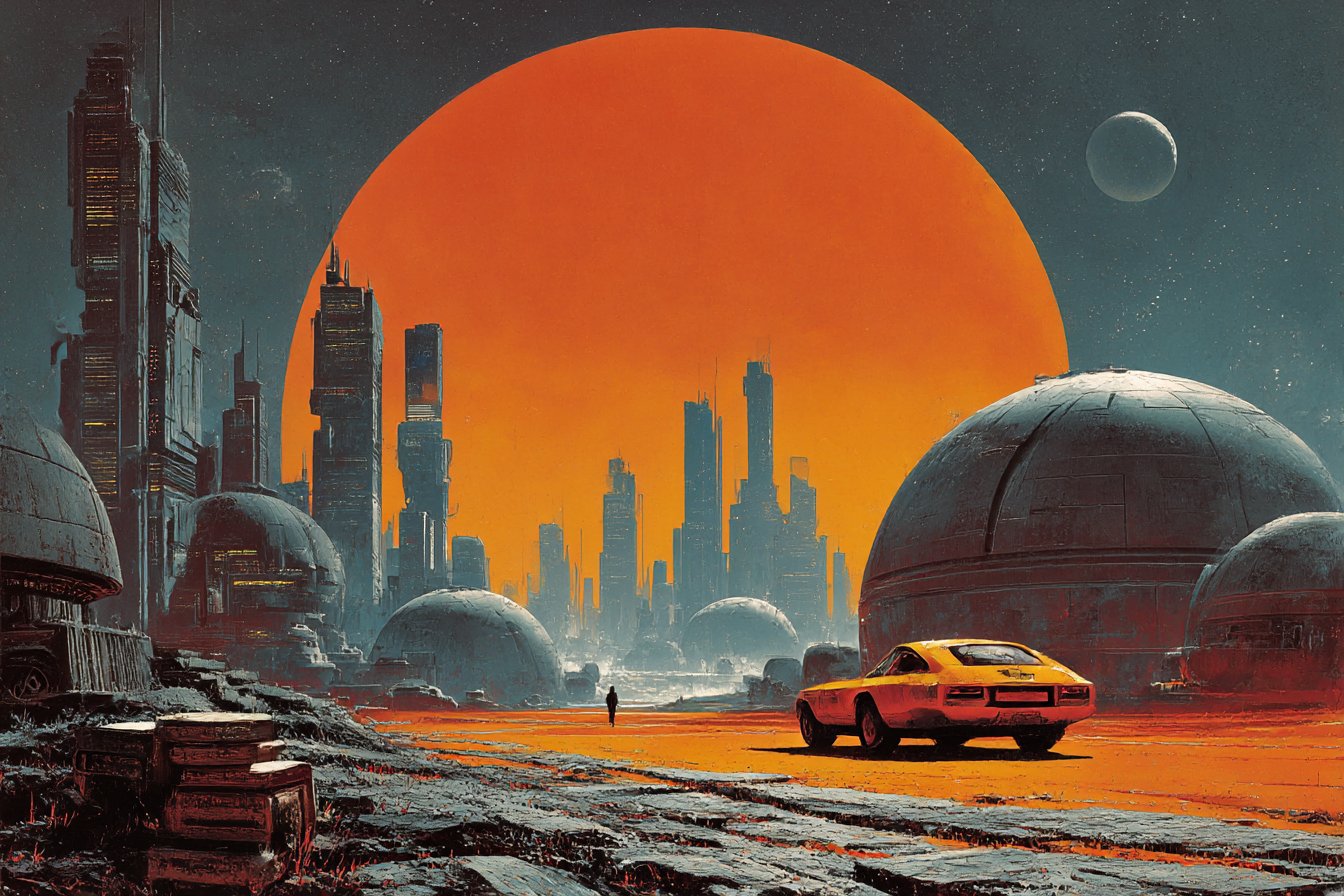

You know what's funny? I used to think Isaac Asimov was just some guy who wrote robot stories until I picked up "Foundation" at a car boot sale for fifty pence. The cover was falling off, pages yellowed with age, but by page three I realised I was holding something that had fundamentally rewired how entire generations thought about the future. That's when it hit me — some writers don't just tell stories, they literally reshape the DNA of imagination itself.
Last month, while sorting through my collection of battered paperbacks (yes, I still buy physical books, don't judge), I started thinking about which authors actually changed the game. Not just the ones who sold millions of copies, but the ones whose ideas became so embedded in our cultural consciousness that we barely recognise them as fiction anymore. The ones who looked at the world and said "but what if…" and then built entire universes around that question.
Asimov's the obvious starting point, isn't he?

The man basically invented the rules for how robots should behave — those three laws that every AI researcher still references today. I remember reading "I, Robot" and thinking how these weren't just stories about machines, but about the ethics of creation itself. What responsibility do we have for things we build? Can something artificial develop genuine consciousness? These weren't abstract philosophical questions when Asimov wrote them; they were plot devices. Now they're the foundation of actual academic debates about AI development.
But here's what really gets me about Asimov — he made science fiction respectable. Before him, the genre was mostly bug-eyed monsters and ray guns. He brought rigour, logic, actual scientific thinking to speculative fiction. His psychohistory concept in the Foundation series basically predicted data analytics and social media manipulation decades before Facebook existed. That's not just good storytelling; that's prophetic thinking.
Philip K. Dick, though — now there's a writer who messed with reality so thoroughly that Hollywood's still mining his ideas fifty years later. "Blade Runner," "Total Recall," "Minority Report," "The Adjustment Bureau" — they're all Dick adaptations. I've got this first edition of "Do Androids Dream of Electric Sheep?" that I found in a charity shop in Oxford, and every time I flip through it, I'm struck by how Dick wasn't just writing about the future but about the fundamental unreliability of perception itself.

What made Dick revolutionary wasn't his technology predictions (though those were spot-on), but his understanding that the real sci-fi question isn't "what will the future look like?" but "how will we know what's real when the boundaries between authentic and artificial become impossible to detect?" That's our world now, isn't it? Deepfakes, virtual reality, social media personas — Dick saw it all coming.
Then there's Ursula K. Le Guin, who took science fiction and made it about people instead of gadgets. I'll never forget reading "The Left Hand of Winter" for the first time — it completely scrambled my assumptions about gender, society, and human nature. Le Guin didn't just create alien worlds; she used those worlds to hold up a mirror to our own assumptions. Her Earthsea books proved that fantasy could tackle serious themes without losing the sense of wonder that makes speculative fiction magical in the first place.
You Might Also Like

What Le Guin understood better than most was that the best science fiction has always been about the present, not the future. She used alien societies to explore concepts that were too radical or uncomfortable to address directly in contemporary fiction. Gender fluidity, anarchist societies, environmental collapse — themes that are mainstream now but were revolutionary when she was writing.
Frank Herbert deserves mention too, obviously. "Dune" isn't just a space opera; it's a meditation on ecology, religion, politics, and power that happens to be set on a desert planet. Herbert created the template for world-building that every fantasy and sci-fi author since has tried to emulate. The attention to detail — the ecology of Arrakis, the political machinations, the religious systems — it all hangs together because Herbert thought through the implications of every element.
I spent a weekend once trying to map out the ecological systems Herbert describes in Dune, just to see if they actually made sense. They do, mostly. That's the mark of serious world-building — when you can examine the foundation and find it solid.
But here's someone who doesn't get enough credit: J.G. Ballard. While everyone else was writing about space travel, Ballard was writing about inner space — the psychological territory of modern life. "Crash," "High-Rise," "The Drowned World" — these aren't traditional sci-fi in the rockets-and-robots sense, but they're absolutely speculative fiction. Ballard saw how technology was reshaping human psychology and behaviour, and he wrote about it with this cold, clinical precision that made his futures feel inevitable rather than fantastical.

I remember trying to explain Ballard to a friend who only knew mainstream sci-fi, and struggling because Ballard's futures aren't shiny or optimistic.

They're extensions of present-day obsessions and neuroses pushed to logical extremes. That's another kind of prophecy entirely.
The thing is, these authors didn't just write stories — they created languages for thinking about possibility. When we talk about AI ethics, we're using concepts Asimov established. When we question reality in our age of digital manipulation, we're walking paths Dick mapped out. When we imagine different social structures, we're building on foundations Le Guin laid.
That's the real legacy, isn't it? Not just the books or the movies based on them, but the way these writers expanded the boundaries of what we could imagine. They didn't just predict the future; they gave us tools for thinking about futures plural, for recognising that the world we live in is just one possibility among many.
Every time I pick up a contemporary sci-fi novel, I can trace the influences back to these foundational voices. They changed not just the genre, but how we think about change itself.

0 Comments