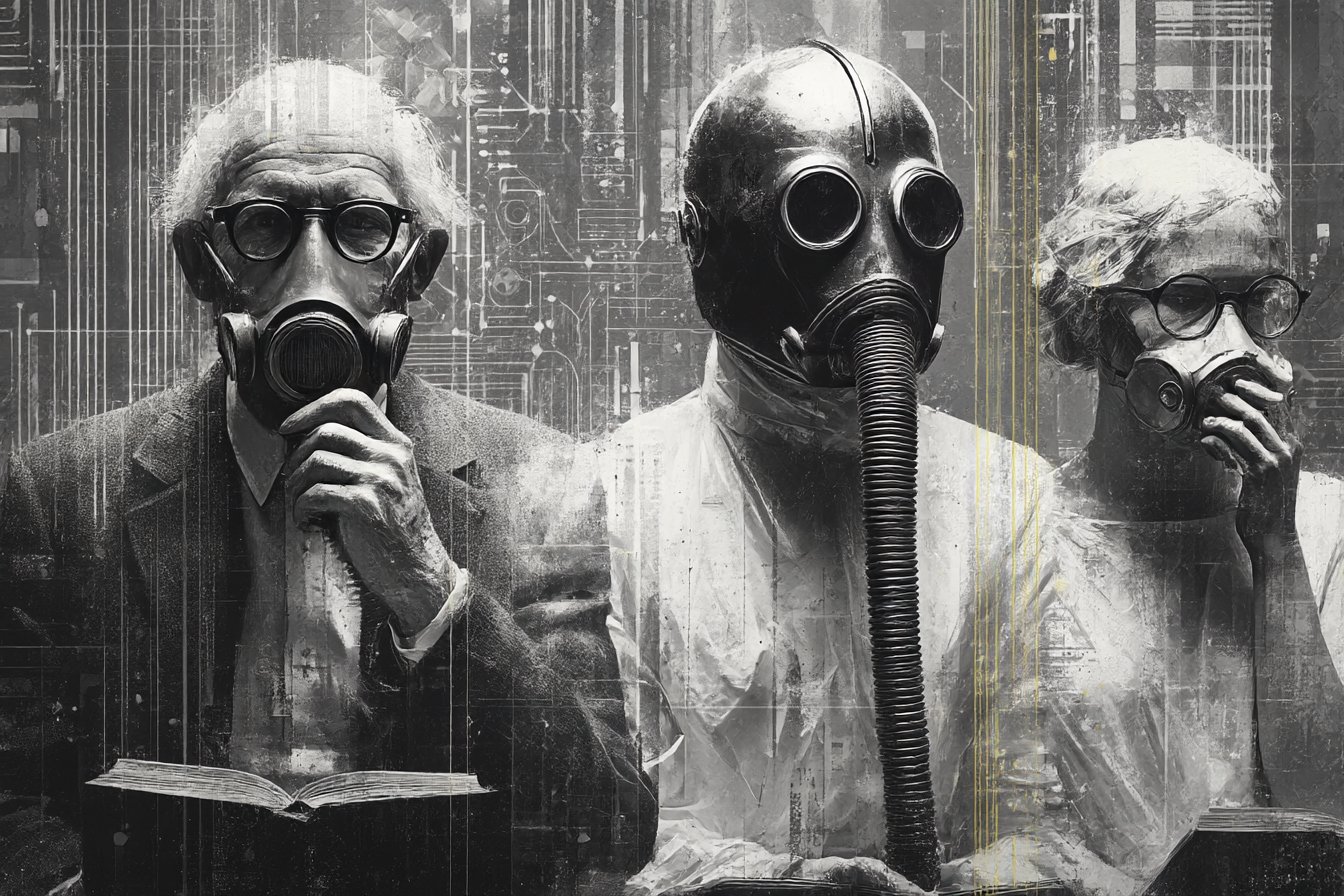

You know what struck me about Becky Chambers' *A Closed and Common Orbit* when I first read it? The way she described the sensation of learning to inhabit a synthetic body — not the grand philosophical implications, but the tiny details. How fabric felt different against artificial skin. How temperature registers as data rather than comfort. I remember putting the book down and thinking, "This is what good sci-fi does." It doesn't just show you the future; it makes you feel what it might be like to live there.
That moment crystallized something I'd been wrestling with for years. We're living through what might be the most exciting period in science fiction history, but you wouldn't know it from the usual "best of" lists that keep cycling through Asimov and Herbert.

Don't get me wrong — those foundations matter. But there's a whole generation of writers out there asking questions that Heinlein never could have imagined, using tools and perspectives that simply didn't exist thirty years ago.
Take Martha Wells' Murderbot Diaries. Sure, the premise sounds familiar — AI security unit gains consciousness, hilarity ensues. But Wells does something brilliant: she makes anxiety the core of her protagonist's personality. Murderbot doesn't want to take over the world or explore the meaning of consciousness. It wants to watch its shows and be left alone, thank you very much. When I mentioned this to my nephew (who's studying computer science), he laughed and said, "That's the most realistic AI I've ever encountered." Kid's got a point.
What excites me about today's sci-fi writers isn't just their imagination — it's their willingness to ground the extraordinary in genuine human experience. N.K. Jemisin didn't just create a world where the earth literally breaks apart in *The Fifth Season*. She built a society that had to adapt to regular apocalypses, complete with survival protocols and cultural responses that feel absolutely plausible. I spent a whole evening sketching out how their geological monitoring systems might work, because the worldbuilding was that convincing.
Andy Weir does this from a completely different angle. *The Martian* works because Weir obsessed over the actual science. I tried growing potatoes in simulated Martian soil after reading it (don't ask how I got the soil mix — it involved way too many Amazon orders and some very confused neighbors). The experiment mostly failed, but I gained immense respect for how Weir made every calculation feel both accurate and necessary to the story.

Then there's Jeff VanderMeer, who's practically invented his own subgenre. *Annihilation* doesn't explain its mysteries — it immerses you in them. The Southern Reach isn't just weird; it's weird in ways that feel organic, almost biological. I remember trying to describe the lighthouse scene to a friend and realizing I couldn't, not really. That's intentional. VanderMeer understands that sometimes the unknown is more powerful than any explanation.
What these writers share isn't a common style or theme — it's an approach. They're not just asking "what if?" They're asking "what then?" What happens to families when faster-than-light travel creates time dilation? How do you maintain democracy when AI can predict voting patterns? What does grief look like when you can upload consciousness?
You Might Also Like

Kim Stanley Robinson tackles climate change not as distant dystopia but as immediate, lived reality. His recent work reads less like fiction and more like dispatches from a future that's already starting. I've been following his interviews and talks, and what strikes me is how he treats science fiction as a form of applied philosophy. He's not just entertaining readers; he's helping them imagine how we might actually navigate the next fifty years.
The diversity of voices matters too, and I don't just mean demographics (though that's crucial). I mean perspectives, experiences, ways of thinking about problems. Nnedi Okorafor brings West African mythology into space opera. Liu Cixin approaches first contact from a Chinese cultural perspective that feels genuinely different from Western assumptions. Ursula K. Le Guin's later work explored gender and society in ways that influenced an entire generation of writers to question basic assumptions about human nature.
Here's what really gets me excited: these writers are creating feedback loops with reality. Entrepreneurs read *Snow Crash* and build virtual worlds. Engineers study *Neuromancer* and worry about AI safety. Climate scientists cite Robinson's Mars trilogy when discussing terraforming research. Fiction isn't just predicting the future; it's actively shaping it.

I've been corresponding with several indie sci-fi writers who are doing fascinating work in smaller venues. They're experimenting with formats, mixing interactive elements with traditional narrative, exploring ideas that might be too niche for major publishers but absolutely captivating for dedicated readers.

One author I know is writing stories entirely from the perspective of ship AIs, another is creating fiction that requires readers to solve actual coding puzzles to unlock chapters.
The tools available to today's writers would seem magical to earlier generations. Real-time collaboration with scientists, access to cutting-edge research, the ability to simulate physical systems and test ideas. I know authors who consult with NASA engineers, marine biologists, neuroscientists. The line between fiction and speculation has never been thinner.
But here's what I find most promising: the best contemporary sci-fi writers understand that technology isn't the story — people are. They're creating characters who feel real enough to care about, then putting them in situations impossible enough to surprise us. That balance, between emotional truth and imaginative leap, is what transforms good sci-fi into lasting art.
These are the writers teaching new generations that science fiction isn't about predicting the future — it's about expanding our sense of what's possible. And honestly? Given the challenges we're facing, we need that expansion more than ever.

0 Comments