











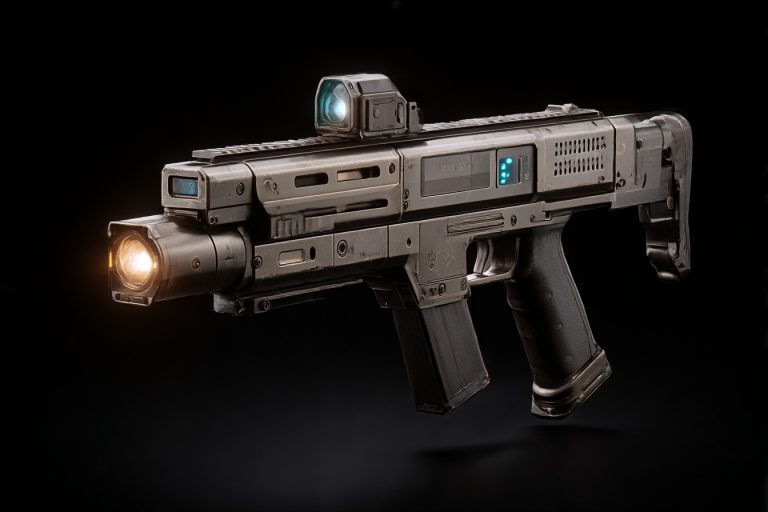

You know what’s weird? I was at a sci-fi convention three years ago – one of those smaller ones in South Jersey where they actually let you touch the props – and I got to hold an original phaser from the ’60s Star Trek series. First thing that hit me wasn’t nostalgia or excitement. It was how *wrong* it felt in my hands. Too light, too smooth, like holding a really expensive TV remote instead of something that could supposedly vaporize a person. But here’s the thing – that wrongness was completely intentional.
I’ve been obsessing over this stuff for years now, especially since I started using more sci-fi in my classroom. Last semester I had my students analyze weapon design in different franchises, and watching seventeen-year-olds dissect the cultural implications of a lightsaber versus a pulse rifle… man, that’s when you know you’ve found something that matters. These imaginary tools aren’t just cool props. They’re doing serious cultural work.
Think about it – Lucas could’ve made lightsabers look like anything. Guns, clubs, staffs, whatever. But he went with something that immediately screams “sword,” which means honor, skill, tradition. Medieval knights and samurai warriors. The elegant hilt suggests craftsmanship; the contained energy blade implies incredible control over tremendous destructive force. When you see someone ignite a lightsaber, you don’t think “death ray.” You think “noble weapon for a more civilized age.” That’s design communicating theme before anyone says a word.
Now compare that to the pulse rifles in Aliens. God, those things are ugly. Chunky, industrial, covered in weird attachments that probably don’t even do anything. They look like tools you’d find in a mechanic’s garage if mechanics specialized in killing xenomorphs. Cameron wanted the audience to immediately understand these weren’t ceremonial weapons or precision instruments. They were brutal, functional implements of war designed by people who needed to kill efficiently and live to talk about it.
I actually tried building a replica pulse rifle once – don’t ask me why, I get weird hobby obsessions sometimes. Used PVC pipes, hardware store bits, way too much spray paint. It was surprisingly tricky getting the proportions right. Too small and it looked like a Nerf gun; too big and you couldn’t actually hold the damn thing. There’s this sweet spot where the design communicates “serious business” without tipping over into “completely ridiculous.” Most people don’t think about that balance, but it’s crucial.
What really gets me is how these designs embed ethical frameworks. Star Trek phasers have stun settings – seems like a tiny detail, right? But it says everything about Federation values. They build weapons that can choose not to kill. Meanwhile, Klingon disruptors are pure aggression. No stun, no mercy, just raw destructive force. The design philosophies reflect the entire cultures. You could teach a whole unit on political philosophy just using Star Trek weapons.
I remember showing Blade Runner to my AP class last year (had to get it approved through three different administrators, but whatever) and pointing out Deckard’s pistol. Thing’s absolutely massive, almost cartoonishly oversized. But that exaggeration serves the story. In a world where you can’t tell humans from replicants, the weapon needs to feel definitively, messily human. Crude, inefficient, analog. A sleek energy weapon would’ve completely undermined the themes Ridley Scott was working with.
Scale matters too, and not just for practical reasons. The Death Star works as a terror weapon partly because its size breaks your brain. It’s not just powerful – it’s existentially threatening, like staring into the void. By contrast, those thermal detonators Leia threatens Jabba with derive their menace from being so small yet supposedly so destructive. Both extremes tap into different primal fears. Big enough to swallow worlds, small enough to hide in your pocket.
When I was working on this space combat simulation last summer (I know, I know, nerd hobbies), I spent way too much time designing the defensive weapon systems. Wanted them to feel like plausible evolution from current military tech. Did research on directed energy weapons, railguns, autonomous defense grids. The challenge wasn’t making them scientifically accurate – it was making them feel believable within the fiction. That’s where good sci-fi lives, in that space between “technically possible” and “dramatically necessary.”
This is why plausibility beats accuracy every time. Audiences will swallow tremendous leaps of imagination if the internal logic stays consistent. Blasters in Star Wars work because they behave predictably – they have recoil, distinctive sounds, leave scorch marks. They feel like tools that exist in a physical universe, even if that universe runs on space magic and the Force.
I’ve been noticing how modern sci-fi increasingly wrestles with automated weapons systems. Drones, AI-guided targeting, weapons that select their own victims. The visual design often emphasizes their inhuman nature – sleek, insectile, lacking traditional grips or triggers. They’re not meant for human hands, and their appearance drives home that separation from human control. Pretty timely anxieties, considering what’s happening with military technology right now.
Here’s something counterintuitive – beautiful weapons in sci-fi often signal moral decay. The ornate blasters in The Fifth Element, those jeweled daggers in Dune, all the fancy killing tools in cyberpunk stories. When a civilization puts that much effort into making weapons aesthetically pleasing, it suggests something deeply troubling about their relationship with violence. Like, maybe they’re too comfortable with it?
On the flip side, some of the most effective sci-fi weapons are deliberately ridiculous-looking. The Noisy Cricket in Men in Black works precisely because it looks like a chrome toy – then delivers planet-cracking recoil. The visual joke reinforces the movie’s whole theme about not judging by appearances, while also being genuinely funny. Comedy and commentary wrapped in one tiny prop.
Most popular

I’ve started collecting replica props – my apartment looks like a very specific type of nerd armory – partly because actually handling them reveals stuff you miss watching movies. Weight distribution, how they balance, sight lines, grip ergonomics. All these factors influence how characters interact with their weapons, which shapes how we read their relationship to violence. It’s embodied storytelling.
Working with 3D printing has taught me about manufacturing implications too. A society that can casually print plasma rifles will develop completely different military doctrines than one where each weapon requires rare materials and master craftsmen. The production method becomes part of the world-building. Mass production versus artisanal creation tells you different stories about scarcity, inequality, social organization.
But here’s what really matters – the best sci-fi weapons force us to confront uncomfortable questions about power and responsibility. When anyone can carry a device capable of leveling city blocks, how does society even function? How do you maintain social order without sliding into authoritarian control? How do you preserve individual dignity when technology makes human life so terrifyingly fragile?
My students get this instinctively, probably because they’re growing up with school shooter drills and climate anxiety and social media harassment. They understand that tools of power carry moral weight. When we analyzed the weapons in The Hunger Games – from Katniss’s bow to the Capitol’s high-tech arsenal – they immediately grasped how each choice reflected different values about violence, resistance, and control.
That’s the real genius of science fiction weaponry. Not their imaginary destructive capacity, but their ability to make us examine our actual relationship with violence, authority, and responsibility. They’re mirrors disguised as ray guns, forcing us to ask what kind of future we’re building and whether we’re ready for the choices it might demand.
Every time I see a new sci-fi movie or show, I find myself studying the weapons design first. Not because I’m some kind of violence fetishist, but because those tools tell you everything you need to know about the world’s moral framework. Show me how a society arms itself, and I’ll show you what it fears most.

Diane teaches English in Philadelphia and uses sci-fi to make teenagers care about literature. She writes about how the genre reflects real-world anxieties—from climate fears to social rebellion—with humor, warmth, and the occasional classroom story.