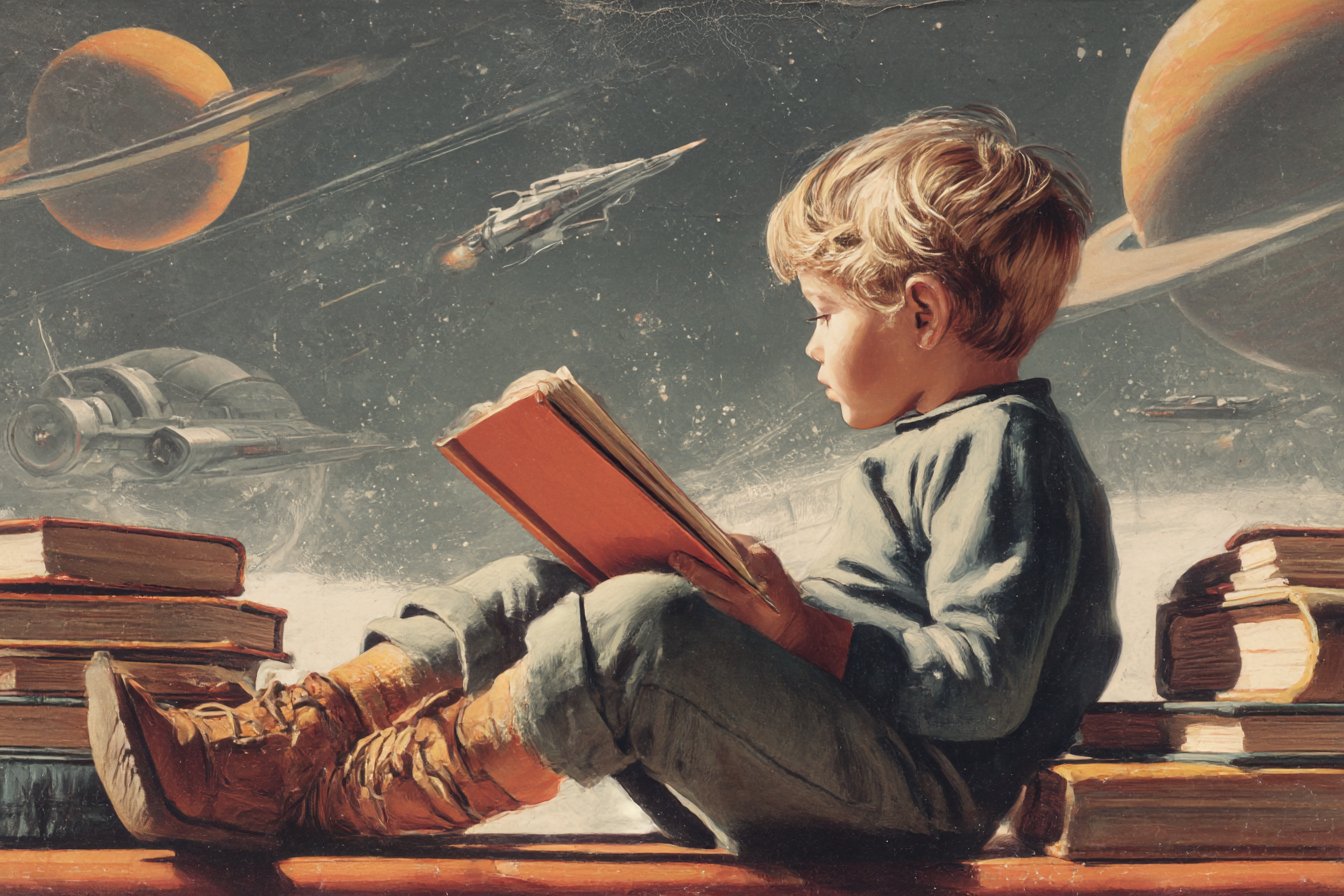

My nephew Jake turned nine last month, and when I asked him what he wanted for his birthday, he said something that caught me off guard: "Uncle, I want books that make me feel like I'm somewhere else entirely." Not toys, not games — books. Specifically, he'd heard older kids talking about stories with spaceships and robots, and he was curious but worried they'd be too scary or too hard.
That got me thinking about my own journey into science fiction as a kid. I mean, there's this sweet spot — maybe ages eight to thirteen — where children are ready for bigger ideas but still need that sense of safety, that reassurance that even when things get strange, there's hope and wonder rather than just darkness. Finding the right sci-fi books for this age group isn't just about avoiding inappropriate content; it's about capturing that perfect balance between "wow, I never thought of that" and "I can actually imagine myself in this world."
I spent the weekend digging through my old collection and hitting up local bookshops, looking for titles that would work for Jake and other kids like him. What I discovered (or rediscovered) was fascinating — there's actually a rich tradition of science fiction written specifically for younger readers, books that don't talk down to kids but also don't overwhelm them with technical jargon or existential dread.
Take "A Wrinkle in Time" by Madeleine L'Engle. Now, I know everyone mentions this one, but there's a reason it keeps coming up.

L'Engle manages to tackle concepts like tessering (essentially folding space-time) in a way that feels magical rather than intimidating. Meg Murry, the protagonist, is awkward and uncertain — exactly how most kids feel navigating their own lives, let alone interdimensional travel. The science is there, but it's wrapped in emotion and relationships. When I reread it recently, I was struck by how the book treats children as capable of understanding complex ideas if you present them through story rather than lecture.
For slightly younger readers — say, eight to ten — I've become obsessed with the "Commander Toad" series by Jane Yolen. These are picture books, technically, but they're clever enough that older kids don't feel insulted reading them. Yolen takes classic space opera tropes (brave captain, loyal crew, mysterious planets) and plays with them through the lens of anthropomorphic amphibians. It sounds silly, and it is, but in the best way. The humor makes the sci-fi concepts approachable. Kids get introduced to ideas like space exploration, alien contact, and problem-solving in crisis situations without any of the weight that usually comes with those themes.

There's something brilliant about how Monica Hughes approached young adult sci-fi in books like "The Keeper of the Isis Light." Hughes was writing in the '80s, but her work still feels fresh because she focused on what it might actually feel like to be a teenager dealing with completely alien circumstances. Olwen lives alone on a distant planet with only a robot guardian, and when human colonists arrive, she has to grapple with questions about identity, belonging, and what makes someone "human." The science is solid — Hughes did her research on planetary environments and space colonization — but the emotional core is what makes the book work.
You Might Also Like

I've noticed that the best sci-fi for kids often involves characters who are outsiders or misfits finding their place in extraordinary circumstances. Maybe that's because childhood itself can feel like being an alien trying to understand a strange new world. Books like "The Giver" by Lois Lowry tap into that feeling perfectly. Lowry creates a society that seems utopian on the surface but reveals darker truths as Jonas begins to question everything he's been taught. It's not flashy sci-fi — no spaceships or laser guns — but it's deeply speculative, asking what we might lose if we tried to eliminate all discomfort and uncertainty from human experience.
For kids who want more adventure and less philosophy, there's the "Space Case" series by Stuart Gibbs. These are murder mysteries set on a lunar colony, which already sounds fantastic, but Gibbs manages to make the setting feel lived-in and realistic. The main character, Dashiell, is twelve and dealing with typical middle-school social dynamics while also solving crimes in low gravity.

The books are funny and exciting, but they also sneak in real information about space habitats, life support systems, and the challenges of living away from Earth.

What strikes me most about successful sci-fi for younger readers is how it handles the "sense of wonder" that's supposedly central to the genre. Adult sci-fi often goes for awe through scale — vast galactic empires, mind-bending physics, cosmic horror. But kids don't need that kind of magnitude to feel wonder. They can get just as excited about a robot companion, a garden growing in artificial sunlight, or the simple weirdness of what it might feel like to walk on a planet with different gravity.
I've also started paying attention to diversity in these books, both in terms of characters and the kinds of futures they imagine. N.K. Jemisin's "The City We Became" is probably too complex for most kids, but her approach to world-building — imagining futures that aren't just technologically different but socially and culturally different too — has influenced a new generation of writers creating sci-fi for younger audiences.
The key thing I've learned from putting together reading lists for Jake and his friends is that age-appropriate doesn't mean dumbed-down. The best children's sci-fi treats young readers as intelligent people capable of handling big ideas, it just presents those ideas through characters and situations they can relate to. These books plant seeds — not just of scientific curiosity, but of the kind of thinking that asks "what if" and "why not" and "how could we do this better?"
When I finally handed Jake his birthday stack of books, he flipped through them with genuine excitement. "These look like real adventures," he said, which I think might be the perfect description of what good science fiction should be, regardless of the reader's age.

0 Comments