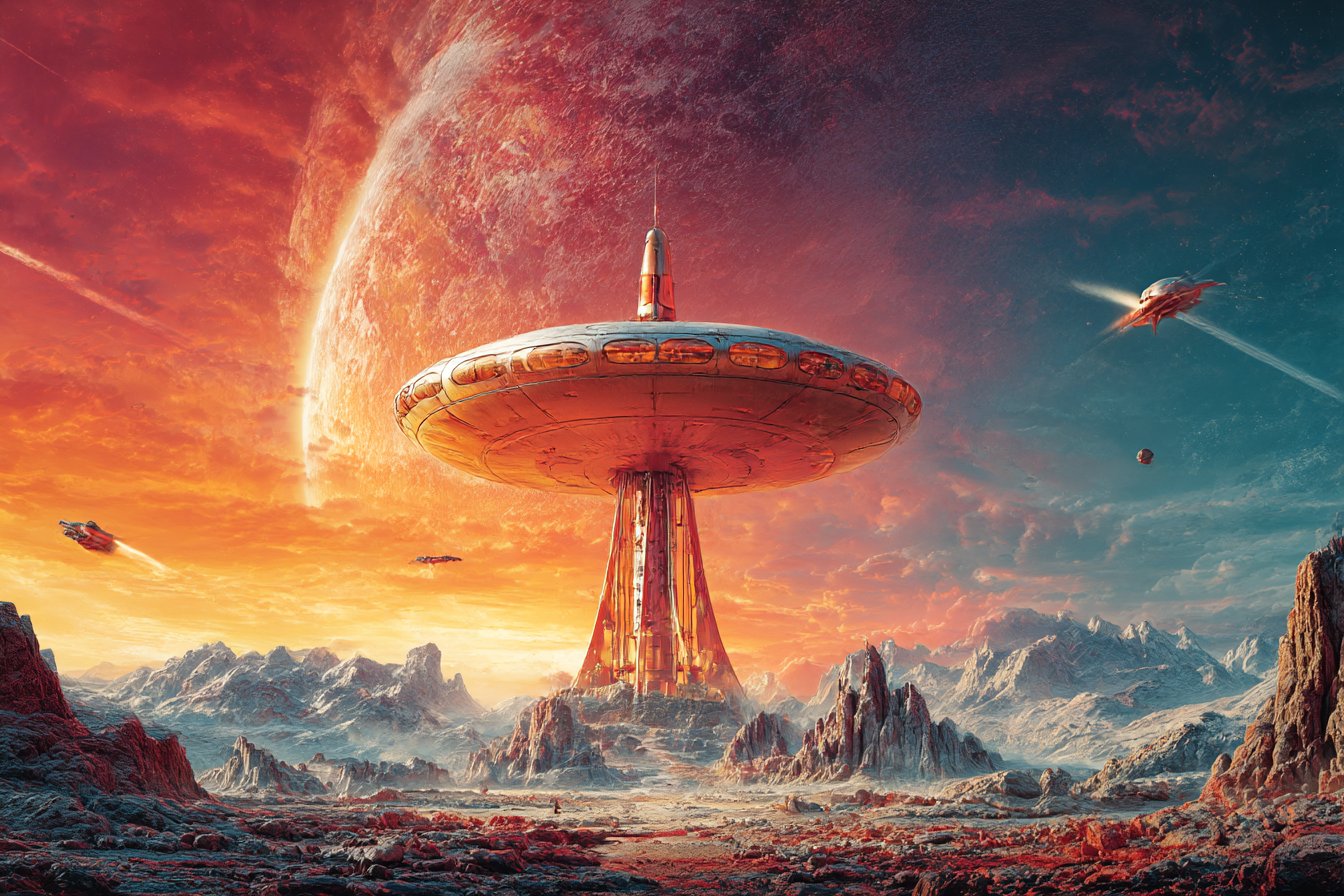

You know what's funny? I was rewatching *2001: A Space Odyssey* last week, and it hit me how utterly confident Kubrick was that we'd have commercial space travel by, well, 2001. There's HAL casually mentioning video calls with Earth like it's checking the weather, and those Pan Am shuttles gliding to space stations as if they're just another Tuesday commute. Watching it now feels like peering into an alternate timeline where we took a completely different technological path.
The 1960s were this incredible pressure cooker for science fiction films — you had the Space Race ramping up, computers starting to enter public consciousness (even if most people had never touched one), and this wild optimism that technology would solve everything. But underneath that chrome-plated future, there was also this creeping anxiety about what we might be unleashing.
I've been digging through my collection of '60s sci-fi films lately, trying to understand what made them tick. It's not just nostalgia driving me — though I admit there's something charming about those clunky robots and blinking light panels.

What fascinates me is how these movies served as both wish fulfillment and warning system for an entire generation.
Take *Fantastic Voyage* from 1966. The premise — shrinking humans to microscopic size for medical procedures — is completely bonkers from a physics standpoint. But watching it, you can feel this incredible faith in scientific progress. The idea that we could miniaturize not just technology but people themselves? That's pure '60s optimism right there. They genuinely believed we were on the verge of conquering everything: disease, distance, even death itself.
I remember trying to calculate the energy requirements for Raquel Welch's shrinking scene when I was studying physics. The numbers are… well, let's just say you'd need to harness the output of several stars. But that's missing the point entirely. The film wasn't really about the science — it was about this moment in history when people believed science could do anything if we just tried hard enough.

*Planet of the Apes* hit theaters in 1968, and man, what a gut punch that was. Here you have this seemingly straightforward adventure story that suddenly becomes this devastating commentary on human arrogance and nuclear paranoia. That final scene with the Statue of Liberty buried in sand? Pure nightmare fuel. But it's also peak '60s sci-fi — using the future to hold up a mirror to the present and asking, "Is this really where we're headed?"
The thing about '60s sci-fi is how it balanced wonder with terror. *Barbarella* gave us this psychedelic space fantasy where pleasure and technology merged in the most '60s way possible. Meanwhile, *The Andromeda Strain* (okay, technically 1971, but based on Crichton's '69 novel) showed us how our technological hubris could literally kill us all through microscopic means we barely understood.
You Might Also Like

What really gets me is how these films handled artificial intelligence. HAL 9000 wasn't some Terminator-style killing machine — he was polite, helpful, even apologetic as he systematically eliminated the crew. That's so much more unsettling than outright hostility. The fear wasn't that machines would hate us, but that they might make coldly rational decisions that happened to involve our deaths. Given what we're dealing with in AI today, HAL feels less like science fiction and more like prophecy.
The visual language these films established still influences how we imagine the future. Those clean, sterile corridors, the beeping computers, the sliding doors that somehow know when you're approaching — it's all become shorthand for "futuristic." I was building a home automation system last year (yes, I'm that guy), and I caught myself programming the lights to fade on and off slowly, just like in *2001*. Why? Because that's what the future is supposed to look like, apparently.
But here's what's really wild about '60s sci-fi — it was incredibly earnest. These weren't cynical cash grabs or ironic commentaries. The filmmakers genuinely believed they were showing us possible futures, both good and bad. When *Star Trek* premiered in 1966, Roddenberry wasn't just making entertainment — he was modeling a future where humanity had overcome its petty divisions and ventured out among the stars with optimism and curiosity.
That earnestness extended to the science, too. Sure, most of it was complete nonsense, but it was carefully constructed nonsense. The creators did their homework, at least within the limits of 1960s scientific knowledge. They'd consult with NASA, bring in scientists as advisors, and try to make their impossible technologies feel plausible. It's that commitment to internal consistency that makes these films work even when the physics falls apart under scrutiny.

I think that's what we've lost in a lot of modern sci-fi — that sense of possibility mixed with genuine concern about consequences. The '60s films weren't afraid to suggest that maybe, just maybe, we were on the verge of something incredible. Or terrible. Often both.
Watching these movies now is like opening a time capsule filled with dreams and nightmares. Some of those dreams came true — we do carry computers in our pockets, we have video calls with people on the other side of the world, we've even got a few robots walking around.

But we're also living with some of those nightmares — surveillance technology that would make HAL jealous, environmental destruction that makes the dead Earth in *Planet of the Apes* feel uncomfortably possible.
Maybe that's why I keep coming back to these films. They remind me that the future isn't inevitable — it's a choice we make, one decision at a time. The '60s sci-fi filmmakers understood that technology isn't neutral. It amplifies who we are, for better and worse.
And honestly? Sometimes I miss that combination of wonder and worry, that sense that we were standing at the threshold of something genuinely transformative. These days, the future often feels more like an extension of the present, just with better smartphones and worse privacy. But those '60s films? They dared to imagine we might become something completely different.

0 Comments