














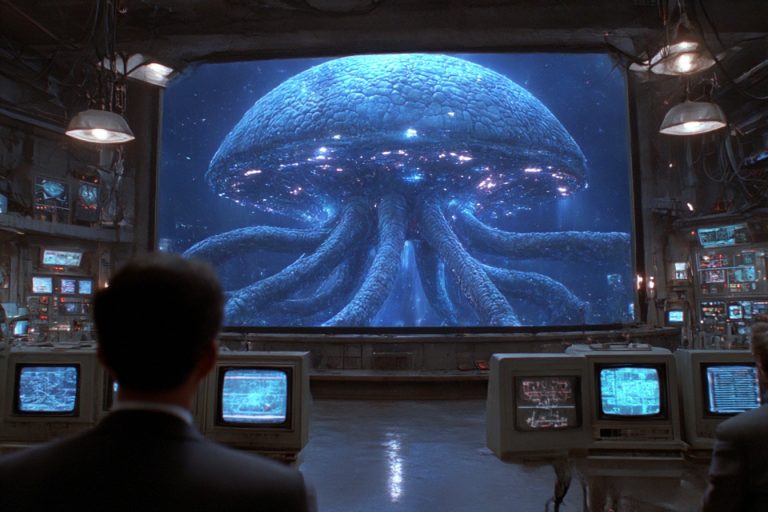

So I’m digging through this pile of old DVDs the other day – yeah, physical media, sue me – and I pull out this battered copy of The X-Files season four that I bought at some sketchy pawn shop years ago. Half the episodes skip, the case is cracked to hell, but I throw it in anyway and within five minutes I’m completely hooked again. Got me wondering… why does this stuff from twenty-five years ago still hit harder than whatever Netflix is trying to shove down my throat this week?
I mean, think about it. Fire up any modern sci-fi show and you get these pristine visuals, budgets that could fund small countries, and writing that somehow manages to explain everything while saying absolutely nothing. But pop in an episode of Babylon 5 from ’94 and boom – you’re invested. The CGI looks like it was rendered on a calculator, but you don’t care because the story actually means something.
Here’s the thing that drives me crazy about current sci-fi television – it’s all surface. Pretty effects, attractive actors, and plots that dissolve the moment you think about them for more than thirty seconds. These 90s shows? They trusted you to have a brain. Take The X-Files episode “The Erlenmeyer Flask” – on the surface it’s about alien-human hybrids, but really it’s asking whether we can trust the institutions that claim to protect us. That’s not just good TV, that’s legitimate social commentary wrapped up in monster-of-the-week packaging.
My buddy Jake was absolutely obsessed with Babylon 5 back in college. Used to quote Straczynski like he was Shakespeare, going on about five-year story arcs and character development. I thought he was nuts at first, but damn if he wasn’t onto something. That show didn’t just reset everything at the end of each episode like most stuff did back then. Actions had weight. Characters grew, made mistakes, lived with consequences. When someone betrayed their principles, you saw them struggle with that choice for seasons.
Deep Space Nine pulled off something similar but flipped the whole Star Trek formula on its head. Instead of boldly going where no one had gone before, they were stuck managing this backwater space station dealing with refugees, religious fanatics, and political nightmares. Sisko wasn’t this perfect Starfleet captain making moral speeches – he was a guy trying to hold everything together while making choices that would’ve horrified Kirk or Picard. Remember when he literally poisoned a planet’s atmosphere to catch one fugitive? That’s not heroic, that’s human.
The production constraints actually made these shows better, which is weird to think about. Babylon 5 had a budget that wouldn’t cover the catering on a Marvel movie, so they had to focus on writing and character development. Every special effect had to earn its place. Every death mattered because they couldn’t afford to waste screen time on throwaway moments.
I tried watching that new Lost in Space reboot last year – gorgeous effects, solid acting, production values through the roof. But three episodes in, I realized I didn’t give a damn about any of these people. They were just walking collections of traits: stern military dad, genius scientist mom, rebellious teenager. Compare that to the original Quantum Leap, where every episode lived or died on whether you believed Sam Beckett genuinely cared about helping whoever he’d leaped into. Scott Bakula sold that compassion so completely that you bought the entire ridiculous time-travel premise just to watch him try to save one more person.
What kills me about modern sci-fi is the impatience. Everything has to be explained immediately, every mystery solved by the season finale, every character arc wrapped up with a neat little bow. These 90s shows weren’t afraid to let questions hang in the air. The Outer Limits reboot would drop you into these weird scenarios and trust you to figure out what they meant. No exposition dumps, no characters explaining the theme to each other – just pure storytelling that stuck with you for days.
I’ve been rewatching Quantum Leap recently – yeah, I know it’s cheesy, fight me – and what strikes me is how cleverly it used the sci-fi premise to tackle real issues. Sam would leap into a Black man in the Jim Crow South, or a woman trying to break into a male-dominated profession, and suddenly you’re experiencing discrimination firsthand. No lectures, no ham-fisted messaging – just the reality of walking in someone else’s shoes, literally.
The X-Files approached social commentary from the other direction. Instead of time travel, they used paranormal investigation to examine contemporary anxieties. Every monster was really a metaphor – corporate culture as mind control, government surveillance as alien abduction, environmental destruction as toxic mutations. The show’s genius was making abstract fears concrete. Worried about losing your individuality in modern society? Here’s an episode where people literally dissolve into collective consciousness.
Another thing these shows got right was technology. They weren’t obsessed with gadgets for their own sake – the tech served the story, not the other way around. Sure, Star Trek had its phasers and transporters, but the focus was always on how technology affected relationships and moral choices. When Deep Space Nine introduced the Dominion War, they didn’t just give everyone bigger weapons – they explored how prolonged conflict corrupts ideals and changes good people into something they don’t recognize.
These shows weren’t afraid to get weird, either. Twin Peaks threw FBI agents, backwards-talking dwarfs, and interdimensional demons into a blender and somehow made it all work. The X-Files could bounce from government conspiracy to broad comedy to existential horror within the same season, and it felt natural because the writers committed to whatever story they were telling. Modern shows are so focus-grouped and committee-written that they’ve forgotten how to take risks.
Maybe what I miss most is the sense of genuine discovery. These weren’t shows building massive fictional universes with spin-off potential and merchandising opportunities. They were content to ask “what if?” and follow that question wherever it led, even if the destination was uncomfortable or incomplete. They treated their audiences like adults who could handle ambiguity and moral complexity.
Most popular

That’s why they still work. Not because of nostalgic attachment or rose-colored glasses, but because they understood something current sci-fi has forgotten – the best genre television isn’t about predicting the future, it’s about understanding the present through a different lens. And honestly? We could use more of that right now.

Logan lives in Minneapolis with too many consoles and just enough opinions. He explores how sci-fi plays differently across games, TV, and film—celebrating great world-building and calling out lazy tropes. Expect passionate takes, sarcasm, and the occasional Mass Effect reference.