












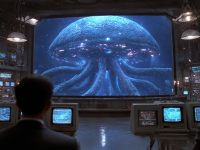



I was watching *Arrival* again last week — probably my seventh or eighth time through, which is embarrassing to admit but here we are — when something finally clicked that I’d been missing. Amy Adams isn’t just figuring out how to talk to aliens. She’s literally experiencing time differently because their language rewires how her brain processes causality. The heptapods don’t think in linear time, so their communication doesn’t work that way either, and suddenly Louise can see her whole life at once. That’s when I finally got what people mean when they talk about “spin” in science fiction.
You know those gyroscopes they sell at science museums? No matter how you tilt the frame, the spinning disc inside keeps its orientation. Spin in sci-fi works kind of like that, except in reverse — it’s the angle from which you approach reality, and that angle determines everything you see. Change the spin, change the story, even if all the facts stay exactly the same.
My friend Marcus teaches high school English here in Austin, and he was venting to me the other day about his students. They keep asking why they need to read different authors when “it’s all the same story anyway.” He’d been trying to explain how *1984* told from Julia’s perspective would be completely different from Winston’s version, even with identical events happening. Same dystopia, same oppression, but spin Julia’s story as a romance and Winston’s as political awakening, and you’ve got two totally different meanings. That conversation got me thinking about how spin works beyond just point of view.
In science fiction, spin isn’t just whose eyes we’re seeing through. It’s about the fundamental assumptions baked into how reality works in that story. Take AI narratives — and God knows we’ve got plenty of those these days. If you start with the assumption that “machines might become conscious,” you end up with stories like *Ex Machina* or *Her*. But spin it to “what if consciousness isn’t what we think it is,” and suddenly you’re in *Blade Runner* territory, questioning whether humans are really conscious either.
I learned this lesson the hard way when I was doing some consulting work on a sci-fi film about two years ago. The director wanted realistic space station interiors, so I spent weeks designing these maintenance corridors based on what seemed logical — wide enough for equipment, proper lighting, clean access panels. When I finally built a mock-up in my garage to test camera angles (my neighbors still think I’m nuts), it felt completely wrong. Too neat. Too organized.
Real maintenance spaces aren’t designed by committees thinking about optimal workflow. They’re improvised solutions to problems nobody saw coming. So I ripped it all apart and rebuilt it with bent panels, jury-rigged cable runs, and that slightly claustrophobic feeling you get crawling around actual mechanical spaces. The difference was incredible — suddenly it felt lived-in instead of designed.
That experience taught me something crucial about spin. It’s not just narrative technique — it’s about honestly examining your assumptions. Most space opera spins from the assumption that future technology will be cleaner, more elegant, more perfectly designed than what we have now. But what if advanced civilizations are just as prone to duct-tape fixes as we are? What if thousand-year-old space stations are held together with the cosmic equivalent of baling wire?
Philip K. Dick was a master of spin, maybe the best sci-fi has ever produced. He didn’t just write paranoid stories — he spun normal reality until the paranoia felt completely rational. In *Do Androids Dream of Electric Sheep?*, the real question isn’t whether the androids are human. It’s whether humanity itself might be artificial, whether empathy can be manufactured, whether the distinction even matters. That’s a complete 180-degree spin on how we normally think about consciousness and authenticity.
What drives me crazy about a lot of modern sci-fi criticism is how it gets bogged down in world-building minutiae while completely missing the spin. I’ve read so many reviews obsessing over whether faster-than-light physics makes sense, while ignoring how the story’s basic assumptions shape everything else. Who cares if your warp drive violates relativity if you’re using it to explore what happens when communication becomes instantaneous? The physics isn’t the point — the social implications are.
I remember struggling with *The Left Hand of Darkness* in film school because I kept getting hung up on the pronouns and trying to figure out the biological mechanics of Gethenian reproduction. Completely missed what Le Guin was actually doing — spinning our entire concept of gender to ask what human relationships might look like without those assumptions. She wasn’t creating weird alien biology for its own sake. She was using that biology to examine power, sexuality, and social organization from an angle we’d never considered.
That’s what good spin does. It doesn’t just change the story — it changes how you think about reality.
I’ve been experimenting with this in my own writing lately. Instead of starting with cool technology or exotic aliens, I start with a question about how we perceive the world. What if memory worked like a library where you could only check out one book at a time? What if empathy were a finite resource that got depleted with use? What if time moved faster for happy people and slower for depressed ones?
Each premise spins our normal assumptions about consciousness, emotion, physics. Forces you to examine things you usually take for granted — like why we assume memory should be perfect, or empathy unlimited, or time constant.
Most popular

The best sci-fi writers understand this intuitively. Kim Stanley Robinson doesn’t just write about Mars colonies — he spins our assumptions about economics, politics, environmental relationships. His Mars isn’t just Earth with red dirt and domes. It’s a place where scarcity economics might not apply, where political structures might evolve differently, where the relationship between humans and environment gets completely reimagined.
Ursula K. Le Guin didn’t just create alien societies for variety’s sake. She spun our assumptions about power structures, social organization, individual identity. *The Dispossessed* isn’t really about anarchism versus capitalism — it’s about spinning the question of whether individual freedom and social responsibility are actually compatible.
This matters beyond literary analysis, by the way. The stories we tell about the future shape how we think about the present. If every AI story assumes artificial consciousness will be hostile, that affects how we approach AI development in the real world. If every climate fiction story assumes inevitable catastrophe, that influences environmental policy discussions. The spin matters because it determines which possibilities we can even imagine.
I’ve started paying attention to this when I’m watching films or reading scripts for work. Not just “is this a good story,” but “what assumptions is this story making, and how do those assumptions limit or expand our thinking about actual possibilities?” Sometimes the most radical thing about a piece of science fiction isn’t its technology or aliens — it’s the angle from which it approaches questions we thought we already understood.
The real science in science fiction isn’t the gadgets or the space travel. It’s the systematic examination of how changing one variable changes everything else. That’s what spin gives you — a way to isolate assumptions and see what happens when you rotate them just slightly.
And honestly, that might be the most important thing sci-fi does. Not predicting the future or warning about dystopias, but training us to question the angles from which we view reality. Because those angles determine everything.

Dylan grew up rewinding VHS tapes to study practical effects and never really stopped. Now based in Austin, he writes about sci-fi cinema with the eye of a filmmaker and the heart of a fan—celebrating the craft, the weirdness, and the magic of futures built by hand, not computers.